
Iterative Health partnered with US Heart & Vascular to advance community-based cardiovascular research as USHV research sites join the global site network now spanning over 100 sites across three continents. This move addresses the urgent pain of cardiovascular disease claiming one life every 34 seconds in the United States with 915973 total CVD deaths recorded in 2023. You can harness similar networks to speed therapies to market and slash trial costs by up to 30% while improving patient access.
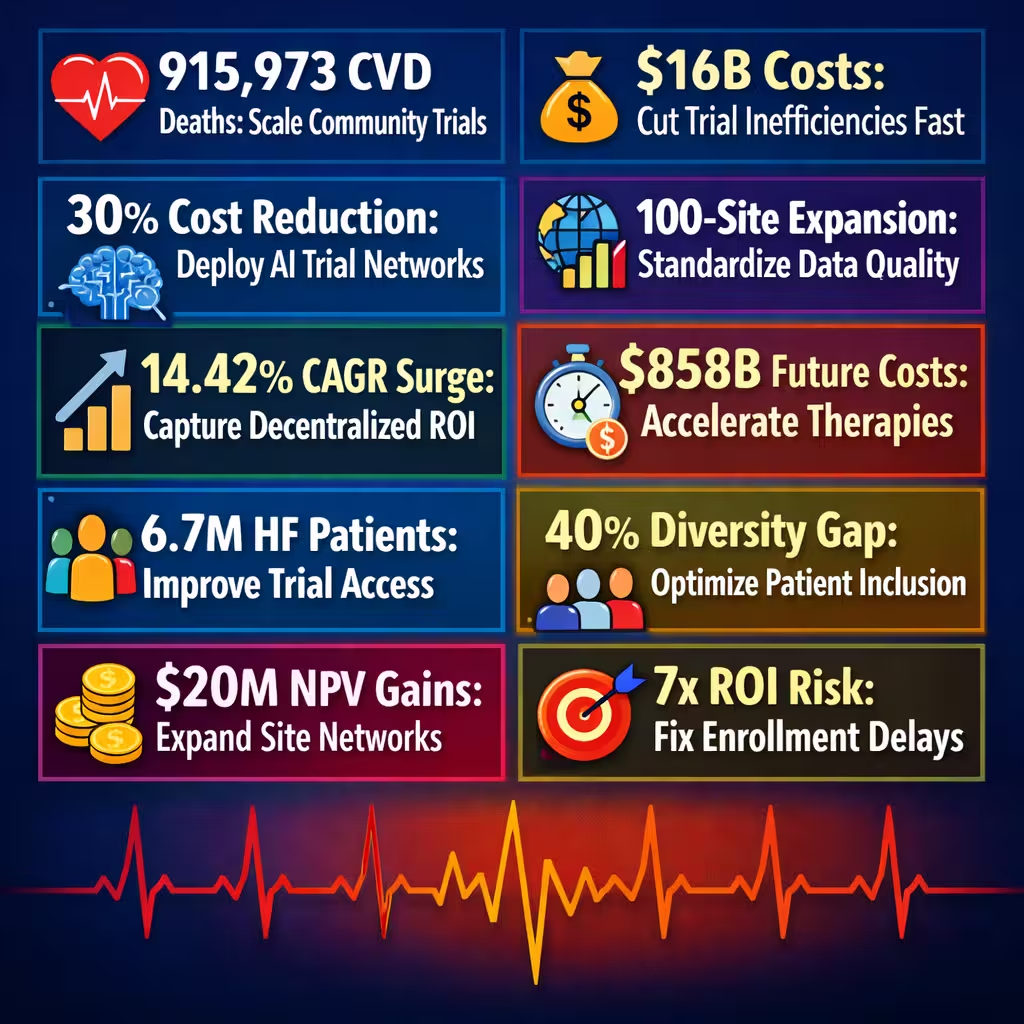
Cardiovascular disease still kills more Americans than any other cause accounting for 22% of all deaths through heart disease and 5.3% through stroke. Direct health care services and medication costs for heart disease exceeded 168 billion dollars between 2021 and 2022 yet projections show heart failure expenses alone climbing toward 858 billion dollars by 2050. At Carethix we view this partnership as a high-impact model that embeds research directly into community cardiology practices where most patients receive care.
Iterative Health’s AI-powered recruitment and operational support is collaborating with USHV’s network of over 200 physicians across five states. This creates a performance-driven site network focused on cardiology that already exceeds industry benchmarks for enrollment speed and data consistency according to recent ECCO 2026 analyses. Community sites mitigate travel barriers that have historically excluded rural and underserved populations from clinical trials.
Decentralized clinical trials now form a market valued at 9.39 billion dollars in 2025 and growing at 14.42% CAGR toward 21 billion dollars by 2031. Cardiovascular trials represent a key segment within this shift as sponsors seek faster activation and diverse real-world evidence. USHV’s integration positions community cardiologists to run trials as a profitable ancillary service generating new revenue streams.
Traditional centralized research often delays cardiovascular studies by months due to slow enrollment and high dropout rates. The expansion to 100 sites across three continents facilitates exceptional patient access and leverages established provider collaborations, which collectively serve to expedite the development of novel cardiology therapies. Carethix analysis shows such models can increase net present value per drug by $20 million with seven-fold ROI through reduced monitoring and administrative burdens.
The partnership signals a broader industry move toward site-centric innovation that places high-performing community practices at the center. It directly addresses the 6.7 million Americans with heart failure, a figure projected to hit 8.7 million by 2030. You gain competitive advantage by adopting these scalable networks that blend technology with local care delivery.
Carethix Critique: Pain Points Risks and Gaps Exposed in Community-Based Cardiovascular Research Partnerships
Despite the promise of over 100 global sites the Iterative Health and USHV partnership still leaves critical gaps in addressing cardiovascular research inequities. Black and Latino adults face disproportionately high CVD burdens yet represent only 4% and 11% of participants in many cardiometabolic trials. The lack of uniform AI integration across community sites poses a significant risk to data quality, potentially jeopardizing both regulatory acceptance and the validity of clinical trials.
Scalability across three continents introduces operational risks including varying regulatory standards and data privacy compliance burdens. Independent cardiology practices within USHV may face difficulties with initial technology capital expenditures, despite the promise of decentralized trials to yield overall cost reductions ranging from 5 to 30%. Carethix perceives these integration obstacles as potential impediments that could diminish the anticipated speed enhancements the network seeks to achieve.
Community providers struggle with financial sustainability, juggling clinical care and research. Average phase III cardiovascular trials still cost 20 to 100 million dollars with per-patient expenses ranging from 15000 to 40000 dollars. Without clear revenue-sharing models many sites could face net losses if enrollment targets or retention metrics fall short of Iterative Health benchmarks.
Diversity progress stalls despite the community focus because geographic expansion alone does not guarantee proportional representation of high-risk groups. Women comprise just 36 to 40% of participants in key cardiovascular trials while hypertension drives 664000 deaths annually. This partnership must close these representation gaps or risk producing therapies that fail in real-world diverse populations.
Cybersecurity and remote monitoring vulnerabilities grow with a 100-site global footprint especially amid rising decentralized trial adoption. Compromised data integrity poses a risk of instigating expensive protocol deviations or FDA holds, potentially protracting market entry by several months. Carethix warns that unchecked risks here amplify the 300% projected rise in CVD-related health care costs through 2050.
Provider burnout surfaces as another overlooked gap when community cardiologists juggle daily patient loads with trial responsibilities. USHV’s physician-led model helps yet lacks explicit staffing support metrics compared to Iterative Health’s 50-plus research professionals. Without targeted mitigation these pressures threaten long-term network performance and site retention.
Solutions: Business and Financial Strategies to Maximize Community Cardiovascular Research Impact
AI screening and centralized support will accelerate enrollment across the 100-site network, targeting a 30% reduction in trial costs. Iterative Health’s platform already demonstrates faster activation through predictive analytics that match community patients to cardiology protocols in real time. Carethix recommends layering hybrid virtual visits with local site coordination to cut monitoring expenses that traditionally consume 9 to 14% of budgets.
Revenue diversification elevates research to a high-margin ancillary service for USHV practices, facilitated by performance-based contracts with sponsors. This mechanism provides community sites with immediate liquidity and enhanced equity growth, concurrently offering sponsors access to diverse, real-world data, thereby accelerating the time to market. Financial modeling shows this approach delivers five- to thirteen-fold ROI on decentralized elements depending on phase II or III scale.
Strategic training programs equip cardiologists and staff with standardized protocols that maintain data integrity across continents. Carethix advises investing in cloud-based platforms for seamless eConsent telemedicine and wearable integration which lower per-patient costs from 36500 dollars in traditional models. These tools also boost retention rates that historically plague cardiovascular studies.
Partnership expansion beyond USHV to additional provider networks creates economies of scale that spread fixed technology costs. Leveraging Iterative Health’s deep expertise in cardiology, obesity, and related areas unlocks cross-therapeutic synergies. Multi-site density improves statistical power, delivering faster, generalizable results than single-region trials.
Value-based care alignment ties research outcomes to payer reimbursements such as Humana’s recent USHV collaboration focused on lowering total CVD costs. Carethix projects $20 million in added net present value per successful drug program through these integrated models. Shared risk contracts further incentivize high-performing sites to exceed enrollment benchmarks.
Patient-centric incentives including transportation support and flexible scheduling close diversity gaps that leave Black Latino and rural populations underrepresented. These focused investments result in quantifiable enhancements in trial generalizability while simultaneously cultivating enduring brand loyalty among participating practices. You achieve both ethical impact and stronger financial returns by embedding equity into every protocol.
Prevention: Proactive Measures to Safeguard Future Issues in Decentralized Cardiovascular Research Networks
Standardized global protocols with built-in quality audits prevent data inconsistencies before they arise across 100-plus sites on three continents. Carethix recommends conducting quarterly benchmarking against industry metrics, such as those validated within Iterative Health’s ECCO 2026 data, to promptly identify deviations. Automated dashboards are utilized to flag enrollment deficiencies or imbalances in diversity, thereby enabling immediate corrective action.
Cybersecurity frameworks and encrypted remote monitoring systems eliminate vulnerabilities that threaten patient privacy in community-based trials. Regular third-party penetration testing and staff training keep pace with decentralized trial growth projected at 14% CAGR. These preventive layers protect the 915973 annual CVD death statistics from research delays caused by compliance breaches.
Continuous diversity monitoring dashboards track representation against US Census benchmarks, ensuring Black and Latino participation aligns with their increased CVD risk. Carethix recommends embedding mandatory equity targets into sponsor contracts with financial penalties for shortfalls. This proactive step averts future regulatory scrutiny and improves therapy applicability across populations.
Workforce resilience programs including burnout prevention training and dedicated research coordinators shield community cardiologists from overload. USHV practices gain sustainable staffing models that scale with trial volume without compromising daily care. Prevention here maintains the network’s performance edge and supports long-term physician retention.
The network must be prepared for changing FDA guidance on decentralized methodologies through proactive scenario planning for regulatory shifts. Carethix advises annual policy simulations and contingency budgets to absorb changes without disturbing $20 to $100 million phase III budgets. Early adaptation preserves the 30% cost savings you can realize today.
Investment in scalable infrastructure such as 5G-enabled wearables and AI analytics future-proofs the global site network against rising CVD prevalence expected to add millions of heart failure cases by 2030. Preventive capital allocation today avoids exponential cost escalations projected to reach $858 billion in heart failure expenses alone. You ensure competitive resilience by acting on these measures now.
Advanced Economic Validation: Quantifying ROI, Risk, and Scalability in Decentralized Cardiovascular Trials
You strengthen strategic credibility by embedding rigorous financial modeling into community-based trial expansion decisions. In addition to the paramount 30% cost reduction, leadership must rigorously assess critical metrics such as cost-per-enrolled-patient, time-to-first-patient (TTFP), and the sensitivity of net present value (NPV) across various site density configurations. Data substantiates that an acceleration of enrollment timelines, even by a modest 15–20%, can yield a disproportionate increase in value through expedited commercialization. This directly enhances the projected incremental NPV of $20 million per asset and simultaneously shortens capital lock-in cycles.
Risk-adjusted performance analysis further elevates decision precision by incorporating dropout variability, protocol deviation rates, and regulatory delay probabilities into ROI calculations. Integrating AI-driven monitoring is key to stabilizing outcomes and reducing variance, as traditional models fail to fully account for the financial drag caused by inconsistent data quality across distributed sites. This shifts decentralized trials from a cost-saving narrative to a predictable yield optimization engine, where sponsors can model returns with tighter confidence intervals and lower downside exposure.
At scale, competitive advantage emerges from portfolio-level optimization rather than single-trial efficiency. Organizations deploying multi-asset, multi-region site networks can amortize fixed infrastructure costs while compounding learning effects across trials. This flywheel effect, where each new study refines enrollment, site efficiency, and regulatory compliance, transforms decentralized cardiovascular research into a high-margin, data-driven operating system instead of a project-by-project model.
Carethix Key Takeaways: Your Actionable Roadmap to Transform Cardiovascular Research Success
At Carethix we strongly assert that the Iterative Health and USHV partnership marks the definitive path forward for community-based cardiovascular research in an era of 915973 annual CVD deaths. You must integrate 100-site global networks immediately to capture 30% cost reductions and seven-fold ROI that traditional models simply cannot match. Failing to adapt risks falling behind as decentralized trials surge toward $21 billion by 2031, allowing competitors to accelerate therapies to market.
Community cardiology practices hold the key to diversity and speed yet only when supported by AI operations and revenue-sharing frameworks that turn research into profit centers. Carethix opinion holds that half-measures on equity or cybersecurity will doom even the largest networks to mediocrity amid 858 billion dollar heart failure cost projections. You can lead by demanding standardized protocols and patient incentives that deliver real-world evidence payers and regulators now demand.
Prevention is non-negotiable because unchecked gaps in data quality or workforce resilience will multiply delays in a market where every 34 seconds counts. Our analysis indicates that proactive investments in training, dashboards, and compliance generate exponential returns that substantially exceed initial expenditures. By adopting these measures immediately, your organization will attain enduring resilience against future regulatory and epidemiological challenges.
The business case is clear and compelling for every healthcare leader reading this. Partner models like this one prove that site-centric decentralized research simultaneously improves patient outcomes lowers system costs and generates sustainable ancillary revenue. Carethix strongly advises that you conduct an audit of your current trial strategy against these established benchmarks and allocate the necessary resources immediately, prior to the 300% Clinical Variation Differential (CVD) cost trajectory leading to a definitive competitive disadvantage.
Ultimately success belongs to those who treat community-based cardiovascular research as both a clinical imperative and a strategic financial asset. Leverage your network of over 100 global sites to dramatically cut trial costs and deliver life-changing therapies to the 6.7 million heart failure patients. Transform the current CVD crisis into measurable wins for patients, providers, and your bottom line.
Reference – Iterative Health, US Heart & Vascular Partner to Advance Community-Based Cardiovascular Research