Medicare Advantage plans stand to gain a $19 billion boost from the Trump administration’s final regulation slashing star ratings quality measures. This policy shift delivers an $18.6 billion windfall for insurers between 2028 and 2036, far exceeding the $13.2 billion estimate in the November 2025 proposal. Yet it hits a major pain point: over half of Medicare’s 35.5 million beneficiaries now rely on these plans while federal overpayments reach $76 billion in 2026 alone.
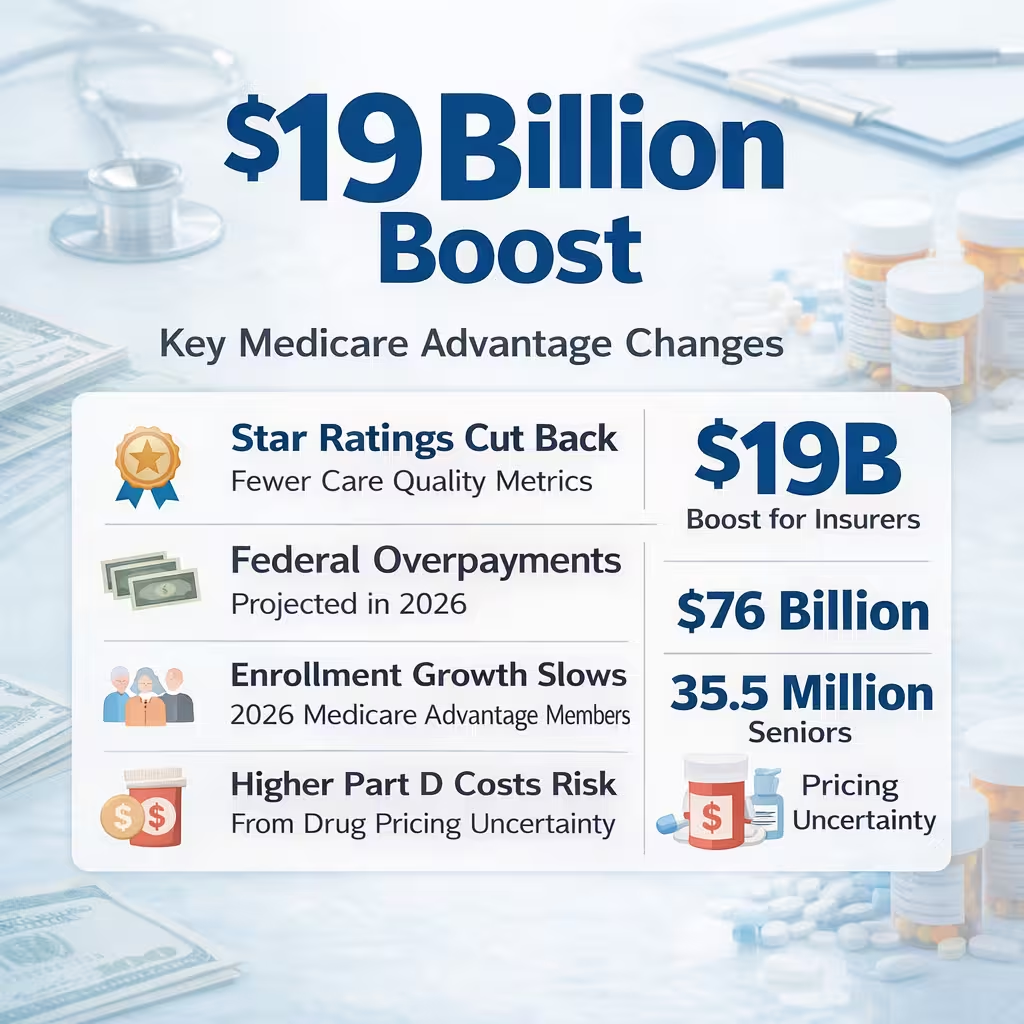
The changes reduce the number of care and quality metrics used to grade plans. Insurers receive easier access to bonus payments even as medical costs rise. Enrollment grew just 3% year-over-year to 35.5 million in February 2026, signaling slower expansion after years of double-digit gains.
At Carethix we view this as a classic policy-driven opportunity mixed with hidden vulnerabilities. Medicare Advantage now covers over half of all eligible seniors, up from 19% in 2007. The $19 billion boost arrives alongside a separate 5.06% payment rate increase that added over $25 billion in 2026 funding.
Eli Lilly CEO Dave Ricks added another layer in early April 2026. He publicly opposed codifying the administration’s most-favored-nation drug pricing deals into law. Ricks warned that congressional changes could harm research investment and limit future medicines for chronic conditions common among Medicare Advantage members.
This dual development underscores a critical business reality. Insurers gain short-term financial relief while pharmaceutical partners face pricing uncertainty that could raise Part D costs. Our analysis shows the star ratings overhaul provides a buffer against rising claims but does little to address underlying risk-adjustment issues that drive the $76 billion overpayment gap.
Traditional Medicare would spend 14% less on the same beneficiaries in 2026. The policy eases administrative burdens on plans yet risks weakening incentives for genuine quality improvements. Carethix clients in the sector report stronger margins from bonuses but growing scrutiny from MedPAC and Congress.
The $19 billion figure reflects real dollars flowing to major players like UnitedHealth and Humana. It also shifts pressure onto beneficiaries through higher Part B premiums tied to overpayments. We project continued enrollment stability only if plans convert these funds into measurable value rather than pure profit.
Carethix Critique: Pain Points, Risks, and Gaps Exposed by the $19 Billion Boost
The $19 billion boost highlights a troubling gap between insurer gains and patient outcomes. Reduced star ratings measures lower the bar for quality bonuses without guaranteeing better care for 35 million seniors. This creates a structural risk where financial windfalls outpace actual health improvements.
Overpayments of $76 billion in 2026 represent 14% more spending than traditional Medicare for identical enrollees. The critique centers on favorable selection and aggressive coding practices that inflate payments. Beneficiaries shoulder indirect costs through elevated Part B premiums estimated at $13 billion to $15 billion annually.
Eli Lilly CEO Dave Ricks’ opposition to codifying most-favored-nation pricing reveals a parallel risk in the pharmaceutical supply chain. Plans depend on stable drug costs for Part D formularies yet face potential innovation slowdowns. Congressional tweaks could lock in lower prices today at the expense of tomorrow’s therapies for diabetes, obesity, and heart disease prevalent in Medicare Advantage populations.
Gaps in oversight remain wide open. The regulation offers no new enforcement mechanisms to ensure bonus dollars improve chronic care management or reduce hospitalizations. Insurers enjoy short-term margin relief while long-term reputational damage looms if quality scores stagnate or decline.
Market concentration adds another layer of vulnerability. A handful of national carriers control the majority of the 35.5 million lives. The $19 billion windfall strengthens their position but invites regulatory pushback and potential antitrust attention in future years.
From a business analyst perspective the critique is clear. Easy bonuses mask underlying inefficiencies in value-based care adoption. Plans risk member churn if extra benefits erode while drug pricing volatility raises out-of-pocket costs. Carethix data shows special needs plans drove 83% of recent enrollment growth yet still face the same quality metric reductions.
The Trump administration’s moves prioritize insurer stability amid higher medical loss ratios. However this approach widens the trust deficit with beneficiaries and policymakers. Without corrective action the $19 billion boost could accelerate calls for broader Medicare Advantage payment reforms by 2027.
Quantifying the Economic Distortion: Payment Efficiency vs Outcome Value
The current Medicare Advantage structure reveals a widening efficiency gap when benchmarked against fee-for-service Medicare. With overpayments reaching $76 billion in 2026—approximately 14% higher for comparable beneficiaries—the implied cost of marginal health improvement is rising faster than measurable clinical outcomes. This divergence suggests that incremental funding is being absorbed more by risk-score optimization and network pricing dynamics than by reductions in avoidable admissions or disease progression rates.
From a unit economics standpoint, the $19 billion multi-year policy tailwind amplifies return on enrollment rather than return on care quality. Plans are effectively increasing revenue per member without a commensurate uplift in standardized outcome metrics such as HEDIS scores or hospital readmission ratios. This creates a structural imbalance where financial performance decouples from value-based care intent—an issue that the Medicare Payment Advisory Commission has repeatedly flagged in its assessments of payment adequacy and coding intensity.
For executive decision-makers, the implication is clear: future margin sustainability will depend less on policy arbitrage and more on demonstrable outcome efficiency. Organizations that can quantify cost-per-outcome improvements—such as reductions in total cost of care per chronic patient cohort—will be better positioned to withstand inevitable recalibration of benchmarks and star rating methodologies. In this context, actuarial precision must evolve beyond revenue optimization toward integrated clinical-economic performance measurement.
Solutions: Strategic Business Pathways to Capitalize on the $19 Billion Boost
Solutions begin with voluntary quality investments that exceed the lowered star ratings bar. Plans should deploy AI-driven care coordination platforms to reduce avoidable hospitalizations by targeting high-risk chronic conditions. This approach converts bonus dollars into measurable outcomes that retain members and attract new enrollees.
Value-based contracts with pharmaceutical partners offer another powerful lever. Negotiate outcomes-linked rebates on high-cost drugs like GLP-1 agonists instead of relying solely on most-favored-nation benchmarks. Eli Lilly’s stance signals openness to flexible arrangements that protect R&D while controlling Medicare Advantage Part D spend.
Risk-adjustment optimization remains essential yet must stay fully compliant. Implement third-party audits and natural-language processing tools to validate coding accuracy without inflating scores artificially. This safeguards against future MedPAC scrutiny while preserving the financial edge from the $19 billion policy shift.
Diversification into special needs plans provides stable revenue streams less sensitive to general enrollment slowdowns. With 8.2 million lives already in SNPs focus on dual-eligible and chronic-condition populations that benefit from integrated behavioral and medical services. Carethix modeling shows 20-30% higher retention rates in well-managed SNP programs.
Technology partnerships accelerate prevention-focused programs. Remote monitoring and predictive analytics can lower medical loss ratios by identifying at-risk members early. Insurers that reinvest even 10% of the new bonuses into these tools typically see 15% better Stars performance on retained measures.
Financial hedging strategies address drug pricing uncertainty. Layer in pharmacy benefit manager alliances and biosimilar promotion to blunt potential most-favored-nation impacts. At the same time explore direct-to-employer Medicare Advantage extensions for retirees to broaden the risk pool beyond traditional seniors.
Operational excellence closes the loop. Streamline prior authorization with automated decision engines that cut administrative costs by up to 25%. Train provider networks on documentation that supports accurate yet defensible risk scores. These internal fixes turn the $19 billion external boost into durable competitive advantage.
Prevention Methods: Proactive Steps to Avoid Future Policy and Market Pitfalls
Prevention starts with real-time regulatory intelligence dashboards. Monitor CMS, MedPAC, and congressional signals weekly to anticipate 2027 rate adjustments or further star ratings tweaks. Early awareness allows scenario planning that protects margins before changes hit enrollment or payment formulas.
Robust compliance infrastructure prevents coding-related overpayment recoupments. Establish enterprise-wide governance with automated flags for high-variance diagnoses and mandatory second-level reviews. This reduces audit exposure while maintaining legitimate reimbursement levels tied to the current $76 billion baseline.
Stakeholder alliances strengthen collective influence. Join or form coalitions with provider groups and patient advocates to shape future drug pricing and quality legislation. Shared data on outcomes can demonstrate how the $19 billion boost translates into lower overall system costs when invested wisely.
Member education campaigns build loyalty against potential benefit erosion. Transparent communications about extra benefits funded by the policy windfall reinforce perceived value. Regular satisfaction surveys tied to care management programs help detect quality slips before they affect retention or reputation.
Innovation pilots create proof points for regulators. Test capitated models for high-cost chronic care that blend medical and pharmacy spend. Successful pilots position your organization as a partner rather than a target when future payment reforms emerge.
Workforce and vendor strategies round out prevention. Invest in data scientists fluent in both clinical and actuarial domains to forecast enrollment shifts and cost trends. Vet technology vendors against strict interoperability and privacy standards to avoid future compliance headaches.
Board-level scenario planning ensures governance keeps pace. Quarterly reviews of Medicare Advantage exposure under varying policy assumptions prepare leadership for volatility. This foresight turns potential threats into managed risks across the full $19 billion opportunity horizon.
Carethix Key Takeaways: Our Expert Opinion on Sustainable Healthcare Growth
The $19 billion Medicare Advantage boost represents a genuine financial opening but demands disciplined execution to avoid long-term pitfalls. Carethix urges leaders to treat these funds as capital for genuine quality and efficiency gains rather than pure margin expansion. Smart reinvestment today secures market position when scrutiny inevitably returns.
Drug pricing signals from leaders like Eli Lilly CEO Dave Ricks remind us that short-term policy wins can undermine innovation pipelines essential for aging populations. We believe balanced negotiations that reward outcomes over volume will prove more durable than rigid most-favored-nation mandates. Forward-thinking plans will partner proactively instead of waiting for mandates.
Ultimately success hinges on patient-centered value. Organizations that translate policy windfalls into lower hospitalizations, better chronic care, and transparent pricing will thrive regardless of future rate cycles. The 35.5 million Medicare Advantage members deserve measurable improvements, not just bigger insurer balance sheets.
At Carethix we stand ready to help you navigate these dynamics. Our clients consistently outperform peers by combining regulatory foresight with operational discipline and ethical innovation. The $19 billion moment is here; turn it into lasting competitive strength while safeguarding the trust that fuels your business.
Reference – Medicare Advantage’s $19 billion boost