Prior authorization cut by 30%—optimize your revenue cycle management to reduce delays, improve approvals, and protect margins.
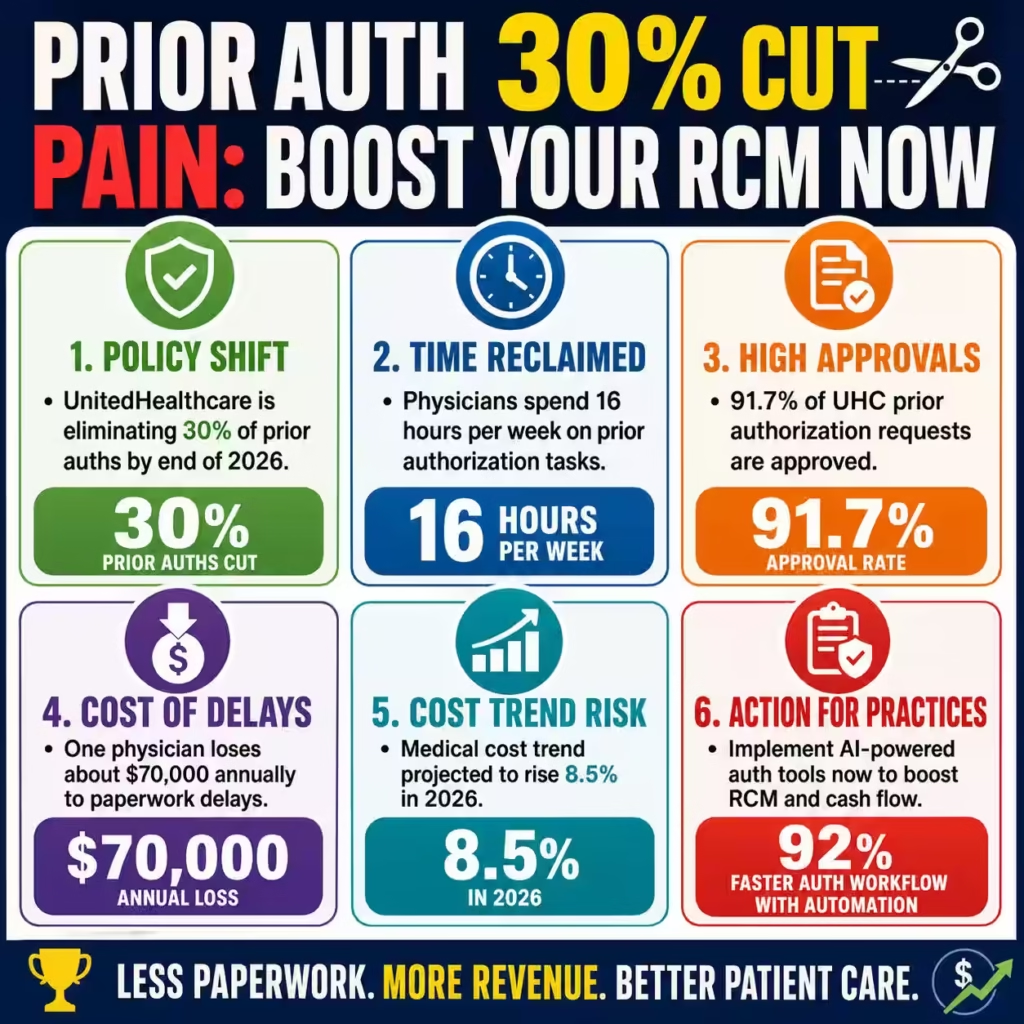
UnitedHealthcare is eliminating authorization requirements for 30% of healthcare services that previously required insurer approval to modernize the care delivery landscape. This move strategically targets nearly 20% of the total administrative friction points identified in 2024, signaling a pivot toward high-trust, data-driven utilization management. By removing barriers for select outpatient surgeries and diagnostic tests like echocardiograms, the organization aims to mitigate the $70,000 annual productivity loss typically incurred by a single physician due to manual paperwork.
This analysis explores how the elimination of these requirements creates a scalable roadmap for your practice to reclaim clinical hours and optimize revenue cycle performance. Recent real-world data indicates that while 92% of authorizations are approved within 24 hours, the cumulative labor cost of the “denial-and-appeal” loop remains a primary driver of the 8.5% medical cost trend projected for 2026. This initiative isn’t just about simplification; it is a calculated financial recalibration designed to align payer profit margins with provider operational efficiency.
UnitedHealthcare’s commitment to eliminate 30% of its remaining prior authorization requirements by the end of 2026 serves as a market-defining response to the $31 billion administrative burden currently strangling U.S. healthcare. While the company reports that only 2% of total medical services require prior approval, the psychological and operational “chokepoint” effect on 1,500 rural hospitals and thousands of specialists is immense. Currently, approximately 91.7% of UHC’s medical claims that do undergo review are approved, yet the 16 hours per week physicians spend on these submissions represent a massive opportunity cost in patient throughput.
This strategic reduction targets specific high-volume, low-variance categories such as outpatient therapies and chiropractic care where clinical consensus is already high. By streamlining these workflows, the organization is effectively outsourcing low-risk utilization management back to the clinician, provided they maintain the 92% approval threshold required for the “Gold Card” status. The financial implications of this shift are profound for B2B stakeholders who manage large-scale provider networks or medical billing entities.
As UnitedHealthcare standardizes electronic submissions—aiming for 70% adoption by year-end—the transition from manual faxing to real-time API-driven verification is expected to reduce the “denial-by-error” rate by up to 40%. Data from the 2024 MGMA Regulatory Burden Report shows that 88% of practices find the prior authorization process “extremely burdensome,” directly contributing to the 33% physician burnout rate. UnitedHealthcare’s move to waive requirements for Medicare Advantage—which already has fewer mandates than competitors—creates a competitive moat that attracts high-performing provider groups.
This is a high-authority play that utilizes “exception-based management” to focus clinical review resources on only the most complex, high-cost experimental therapies. By narrowing the scope of active reviews, the insurer reduces its own overhead while improving provider relationships across the network. This shift represents the first major domino to fall in a broader industry-wide movement toward administrative transparency and fiscal accountability.
A Critique from Carethix: Addressing Gaps, Risks, and the Invisible Ceiling
While eliminating 30% of authorizations appears beneficial, Carethix identifies a significant risk in the “shadow administrative load” that often replaces formal reviews. The transition to a “notification-only” model for Gold Carded providers still requires practitioners to input data into the UHC Provider Portal, which can take up to 25 minutes per entry if not fully automated. There is a visible gap between the policy announcement and the actual implementation of the CMS-0057-F Interoperability Standards, which are not fully mandated until January 2027.
We critique the reliance on 92% approval rates as a static metric, as this does not account for the “chilling effect” where doctors avoid ordering necessary but “difficult” tests to maintain their status. The 34% of physicians who report that prior authorization delays have led to serious adverse events are not fully addressed by a 30% reduction; the remaining 70% often comprise the highest-risk procedures. Furthermore, the “transparency and accountability” mentioned by CEO Tim Noel must be scrutinized against the backdrop of rising medical cost trends, which PwC projects at 8.5% for 2026.
There is a risk that this reduction in prior authorization is a tactical move to shift the burden of “medical necessity” proof from the insurer to the provider’s retrospective audit defense. If a service no longer requires an “upfront” authorization, it may still face a “post-payment” audit, which is often more costly and disruptive for a practice’s cash flow. The exclusion of nursing facility residents and initial consultations from these new streamlined pathways creates a fragmented care experience for the most vulnerable patient populations.
Without a universal, cross-payer standard, a practice managing 15 different insurers will still face a fragmented “checkerboard” of requirements that negates the efficiency gains of a single payer’s policy. This lack of harmonization means providers must maintain multiple complex workflows despite individual policy improvements. Consequently, the true administrative relief will remain elusive until federal mandates force a consolidated electronic standard across all commercial entities.
| Related Analysis: 840K Deaths Crisis: Strategic Workforce Stabilization $1B Aid Gap Crisis: Sustainable Funding Model Design $109M Deficit Crisis: Secure Your Cost Strategy |
Strategic Business Solutions: Navigating the New Authorization Landscape
To capitalize on UnitedHealthcare’s policy shift, practices must implement an AI-driven “Auth-Intelligence” layer that synchronizes with the UHCProvider.com list of eliminated codes. Leveraging NLP engines to scan clinical notes can auto-populate the 40+ data fields required for the “remaining” 70% of authorizations, reducing manual time from 20 minutes to 2 minutes. By integrating FHIR R4 APIs, your revenue cycle management team can achieve real-time status updates, ensuring that the 92% approval rate is defended through high-quality clinical documentation.
This solution allows you to transition your administrative staff from “paperwork hunters” to “care coordinators” who focus on high-priority patient outcomes. Investing in these automated pathways now will prepare your business for the 2027 CMS mandate while capturing immediate labor savings from UHC’s 2026 reduction. A secondary solution involves the aggressive pursuit of “Gold Card” eligibility by centralizing your Tax Identification Number (TIN) performance data.
Since UHC evaluates eligibility based on two consecutive years of data, you must perform a retrospective audit of your denial reasons to identify “low-hanging fruit” for correction. By reducing “insufficient documentation” denials—which account for 18% of adverse determinations—you can secure an automatic waiver for 18 specific behavioral health and medical codes. This proactive stance turns your compliance department into a profit center by eliminating the 16-hour weekly drain on your highest-paid clinicians.
Implementing a “Standardized Submission Protocol” across your entire practice ensures that even as UHC changes its list of required codes, your operational output remains consistent and efficient. Utilizing centralized data reporting allows for a macro-view of which clinicians are struggling to meet the necessary thresholds for Gold Card status. This data-first approach ensures that your B2B operations are optimized for the highest possible level of reimbursement with the lowest possible administrative friction.
Future-Proofing Your Practice: Prevention and Sustainable Compliance
Preventing future administrative bottlenecks requires a move away from “transactional medicine” and toward “value-based care” models that naturally align with payer incentives. By adopting alternative payment models, you can negotiate “global auth waivers” that go beyond UHC’s 30% baseline, effectively exempting your entire patient panel from routine reviews. This prevention strategy addresses the root cause of the burden by proving that your clinical pathways are consistently evidence-based and cost-effective.
Monitoring your internal “adverse determination” metrics monthly allows you to course-correct before a 92% approval rating slips, preventing the loss of Gold Card status. This ensures your practice is not reactive to policy changes but is a preferred “high-trust” partner for major insurers. Future-proofing also necessitates the implementation of “Clinical Decision Support” (CDS) tools at the point of care to ensure all orders meet UHC’s latest criteria before they are even submitted.
This prevents the “rework” that costs practices an average of $2M per year for a 10-physician group in lost productivity and denied claims. As regulatory bodies like CMS increase transparency requirements, having an auditable trail of “medical necessity” logic within your EHR becomes your strongest defense against retrospective audits. We recommend conducting quarterly staff training on the evolving list of 30% eliminated services to ensure patients are not being delayed for tests that no longer require approval.
This dual-layered approach of technology and education creates a resilient operational framework that thrives regardless of the shifting regulatory or payer landscape. By standardizing these internal checks, you effectively immunize your business against the volatility of policy updates or personnel changes. Ultimately, the goal is to create a self-sustaining compliance environment that requires minimal manual intervention to maintain peak efficiency.
Carethix Key Takeaway: The Verdict on the 30% Reduction Strategy
UnitedHealthcare’s 30% prior authorization reduction is a trap—a strategic “softening” of the administrative wall that is far from a complete demolition. Do not be fooled; you must still aggressively build your own door. The real financial winner in this scenario isn’t the payer, but the provider group that uses this “slack” to aggressively automate their remaining 70% of high-complexity authorizations.
While UHC simplifies the process for a mere 2% of medical services, the broader industry trend toward true interoperability means your “data quality” is now your most valuable currency.
Do not mistake a reduction in “prior authorization” for a reduction in “payer oversight.” The oversight is simply moving from the bureaucratic front-end to a more painful, punitive back-end audit. You must own your data, automate your submissions with zero-defect accuracy, and leverage this 30% gap to scale your patient volume without increasing your dead-weight head count. This specific policy shift is the perfect, low-stakes laboratory to pressure-test your full automation strategies before universal, and inescapable, federal mandates take effect in 2027. Do not wait. Automate now or be left behind.
FAQs:
Will moving to 70% electronic submissions and API-driven workflows eliminate the 40% denial-by-error rate?
Even with 70% digitization, error reduction is capped without standardized cross-payer interoperability, leaving practices stuck in a fragmented, multi-system inefficiency loop.
Does the “Gold Card” model with a 92% approval threshold truly reduce friction or shift risk to providers?
The 92% threshold subtly transfers compliance risk to providers, incentivizing conservative care decisions while exposing practices to costly post-payment audits.
Can eliminating 30% of authorizations realistically offset the projected 8.5% medical cost trend for 2026?
A 30% reduction is operationally cosmetic against an 8.5% cost surge, failing to address deeper inefficiencies like denial cycles and fragmented payer workflows.
If 91.7% of prior authorizations are already approved, why does the $31B administrative burden persist?
A 91.7% approval rate exposes the system’s inefficiency, where high approval volumes still justify low-value bureaucracy that inflates a $31B cost structure.
How will UnitedHealthcare’s 30% prior authorization reduction impact the 16 hours/week physician admin burden?
A 30% cut barely dents the 16-hour weekly drain, meaning without automation, practices will still hemorrhage clinical time and revenue despite marginal policy relief.