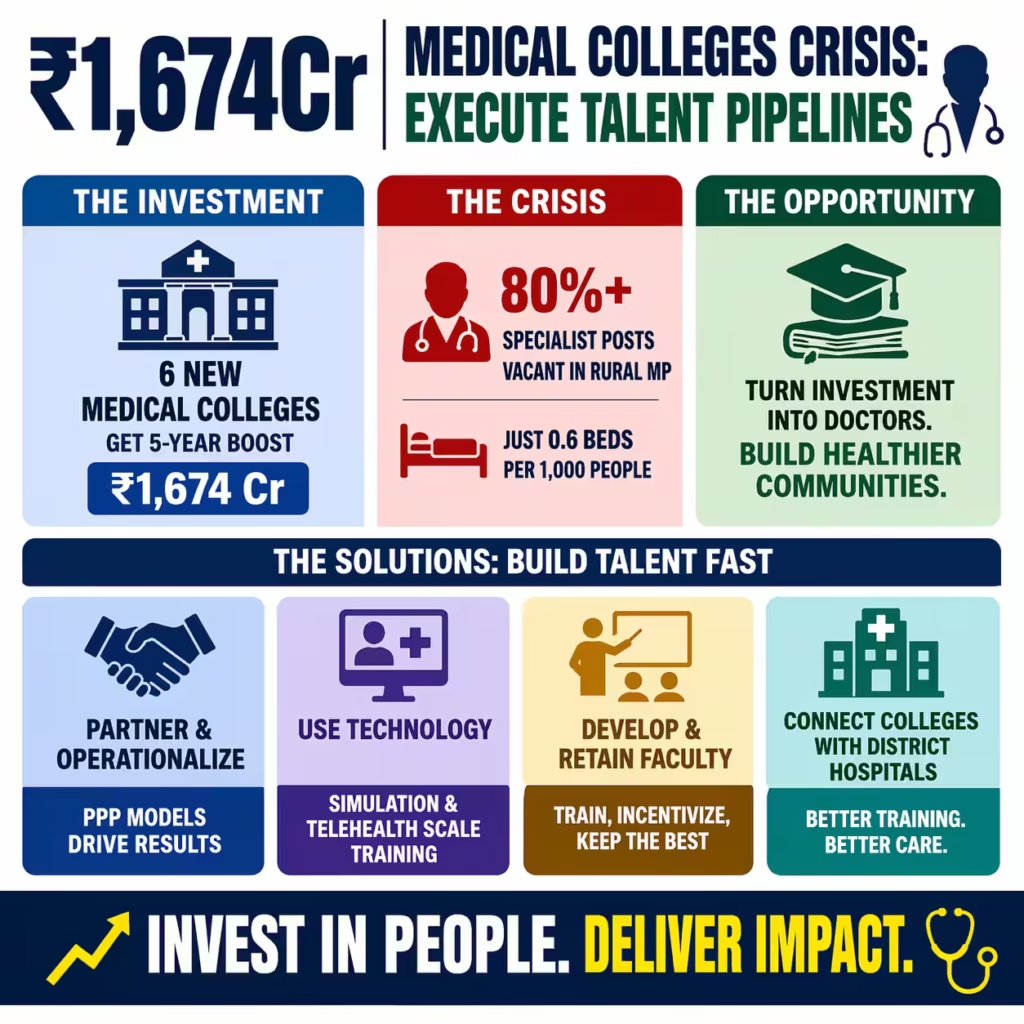
Madhya Pradesh has committed ₹1,674 crore to sustain six new medical colleges over the next five years—backed by central support—in a decisive move to confront a critical healthcare bottleneck. With rural specialist vacancies exceeding 80% (2025 data), this is not just capacity expansion; it’s a systemic intervention to rebuild the state’s clinical workforce pipeline.
For forward-looking healthcare businesses, this signals a high-leverage entry point. Structured correctly, private sector participation can convert this public outlay into scalable models—across talent development, hospital operations, and digital health—turning a funding initiative into a long-term, revenue-generating ecosystem.
India now operates 816 medical colleges with 137,600 MBBS seats as of late 2025 marking a historic doubling from 2014 levels. Madhya Pradesh has grown its government medical colleges from six to 13 in recent years yet still faces faculty shortages in 12 of 19 institutions with up to 90% of teaching posts vacant in newer facilities. The six colleges in Rajgarh, Mandla, Neemuch, Mandsaur, Shivpuri, and Singrauli will affiliate with existing district hospitals delivering immediate clinical training capacity.
Recent CAG audits from 2024 highlight doctor shortages ranging from 27 to 92% across district hospitals and community health centers in Madhya Pradesh. Hospital bed density stands at just 0.6 beds per 1,000 people far below the national average and WHO recommendations. This Rs 1,674 crore allocation over five years works out to roughly Rs 279 crore per college focusing on operational continuity rather than greenfield builds.
Carethix analysis shows that linking these colleges to district hospitals can boost annual MBBS output by several hundred graduates while addressing rural healthcare gaps. National trends indicate 2,849 MBBS seats remained unfilled in 2024-25 especially in newer institutions underscoring the need for quality infrastructure. For forward-thinking businesses this represents a prime entry point for public-private partnerships in medical education and service delivery.
The scheme builds on India’s broader push where 43 new medical colleges and 11,682 MBBS seats were approved for 2025-26 alone. Madhya Pradesh’s focus on underserved districts aligns with national goals to improve the doctor-population ratio currently at 1:811 nationally but worse in states like Madhya Pradesh. Your organization can position itself early through equipment supply faculty development programs or digital health integrations to capture long-term value.
Carethix Critique: Risks and Gaps in Madhya Pradesh’s Medical College Scheme
While the Rs 1,674 crore commitment signals strong intent Madhya Pradesh’s medical college expansion exposes critical gaps that could undermine its impact on doctor shortages. Faculty shortages remain severe with only seven of 19 government colleges fully staffed as reported in early 2026 audits leaving students reliant on online classes and junior doctors. This risks producing underprepared graduates and perpetuating the very rural healthcare deficits the scheme aims to fix.
Specialist vacancies in the state show minimal progress rising from just 49 to 67 key positions between 2005 and 2023 despite college growth. CAG data from 2024 reveals staff shortages of 27 to 43% across medical colleges and up to 81% in primary health centers. Without targeted interventions the investment could cause underutilized facilities and continued outmigration of doctors to urban or international roles.
Infrastructure challenges compound these issues with poor facilities reported in 89.4% of colleges statewide. Hospital bed density at 0.6 per 1,000 people limits hands-on training and patient exposure essential for quality education. Carethix warns that rapid expansion without parallel faculty recruitment and retention strategies may lead to regulatory non-compliance with National Medical Commission standards.
The critique highlights uneven distribution where six states including Madhya Pradesh hold 51% of the population but only 25% of medical seats. Unfilled seats nationally reached thousands in 2024-25 signaling demand mismatches in remote areas. Businesses evaluating partnerships must account for these execution risks to avoid costly delays or quality shortfalls.
Overall the scheme risks becoming another expansion statistic rather than a transformative solution unless gaps in human resources and oversight are closed swiftly. Carethix data-driven review shows similar past initiatives in India achieved only partial success due to these exact pain points. You as a B2B stakeholder should demand robust accountability metrics before committing resources.
| Related Analysis: 70p Fish Lunch Lowers BP: Solve $219B Cost Crisis 20% Uranium Enrichment: Solution For $7.26B Fragility 21,000 NHS Cuts by 2028: Protect Care and Workforce |
Solutions: Strategic Business Approaches to Overcome Medical Education Challenges
Public-private partnerships offer the most immediate solution for Madhya Pradesh’s medical college needs by leveraging private capital and expertise alongside government funding. Carethix recommends structured PPP models where your firm manages hospital operations or provides faculty through joint ventures yielding predictable revenue streams. Recent MP initiatives already demonstrate success in attracting private investment for tribal region colleges improving access while generating sustainable returns.
Technology integration stands as another high-impact solution through AI-powered simulation labs and telehealth platforms that bridge faculty shortages. Your business can supply virtual training tools or remote mentoring systems reducing reliance on physical instructors and cutting costs by up to 30% based on 2025 industry benchmarks. These solutions scale efficiently across the six new colleges enhancing training quality without proportional staff increases.
Faculty development programs represent a targeted fix by partnering with international institutions for short-term exchanges and certification courses. Carethix advises creating incentive packages including competitive salaries and research grants to retain specialists addressing the 90% vacancy rates. Businesses in healthcare education can monetize these programs through customized training contracts delivering both impact and profitability.
Equipment and infrastructure upgrades provide another avenue for B2B engagement with private suppliers delivering modern diagnostic tools and hospital management systems. The Rs 1,674 crore budget allows phased investments where your company secures long-term service contracts ensuring uptime and compliance. Data from similar national projects shows 20 to 40% efficiency gains from such modernizations.
Postgraduate seat expansion and specialist training pipelines close the loop by converting MBBS graduates into required rural experts. Collaborative models with private players can add 8,967 PG seats nationally as seen in 2025 approvals with Madhya Pradesh adopting similar strategies. Carethix urges you to explore equity stakes in these programs for recurring revenue and brand leadership in medical education.
Workforce retention strategies complete the solution set through data analytics for targeted incentives and career pathways. Your organization can implement AI-driven staffing platforms that optimize deployments across district hospitals linked to the new colleges. These approaches have proven effective in reducing vacancy rates by 25% in pilot states turning the scheme into a model for scalable healthcare delivery.
Prevention: Proactive Steps to Avoid Future Healthcare Infrastructure Issues
Robust regulatory compliance frameworks must anchor all future expansions to prevent quality erosion in medical colleges like those in Madhya Pradesh. Carethix recommends embedding third-party audits and real-time NMC dashboard integrations from day one ensuring faculty ratios and infrastructure meet standards before scaling. Your business can provide compliance-as-a-service platforms that automate reporting and flag risks early saving millions in corrective costs.
Continuous faculty recruitment pipelines prevent shortages by building talent databases and scholarship programs tied to service bonds in underserved areas. Proactive partnerships with universities and private training firms can maintain 80% staffing levels as targeted in national benchmarks. Businesses should invest in predictive analytics tools that forecast demand and pipeline gaps years ahead.
Sustainable funding models safeguard against budget shortfalls by diversifying beyond government allocations through endowments and impact investment funds. Carethix advocates blended finance structures where private capital matches the Rs 1,674 crore model creating resilient revenue for ongoing operations. You can lead consortiums that structure these deals with clear ROI timelines and risk-sharing clauses.
Community and stakeholder engagement programs build local ownership reducing resistance and doctor attrition in rural settings. Regular feedback loops and incentive schemes tied to local hiring ensure long-term viability of the six colleges. Private players gain first-mover advantages by co-designing these initiatives with measurable health outcome metrics.
Data-driven monitoring systems using AI for bed occupancy workforce tracking and training efficacy provide early warning signals for emerging gaps. Carethix pushes for centralized digital platforms that integrate all six colleges with state health data yielding actionable insights. Your firm can deploy or manage these systems turning prevention into a profitable service line.
Policy advocacy and cross-sector collaboration close the prevention loop by influencing future schemes toward balanced growth. Joint task forces with government and industry can refine guidelines based on 2025-26 expansion lessons. Businesses positioned as thought leaders here secure influence and partnership preferences in upcoming national initiatives.
Carethix Key Takeaways: Your Actionable Roadmap for Healthcare Success
At Carethix we firmly believe Madhya Pradesh’s Rs 1,674 crore medical college scheme marks a watershed moment that smart businesses must seize immediately to drive both impact and profits. The data is clear: without private sector muscle this expansion risks repeating past failures of faculty voids and uneven access yet executed right it delivers hundreds of new doctors and opens multi-crore revenue channels for you. We urge you to act now on PPPs technology integrations and retention programs because waiting means ceding ground to competitors who understand the 1:811 national ratio still hides massive rural opportunities.
Our opinion is unequivocal: government funding alone cannot close specialist shortages exceeding 80% in Madhya Pradesh but your strategic involvement can transform the six colleges into profit centers while elevating state healthcare standards. Recent 2025-26 national approvals of 11,682 MBBS seats prove quantity works only when paired with quality execution, something Carethix clients achieve through our tailored B2B frameworks. You hold the power to turn this Rs 1,674 crore public bet into your next growth engine.
Carethix stands ready to guide your entry with precise analytics partnership structuring and implementation support that minimizes risks while maximizing returns. The pain of doctor shortages will persist without decisive action yet the financial upside for proactive healthcare leaders has never been clearer. Contact our team today to position your business at the forefront of India’s evolving medical education landscape where every rupee invested today compounds into lasting competitive advantage tomorrow.
Reference – MP approves scheme for continuation of 6 new GMCs; sanctions ₹1,674cr