Connecticut’s $109M deficit exposes rising healthcare costs; strengthen your cost strategy with data-driven actions for stability.
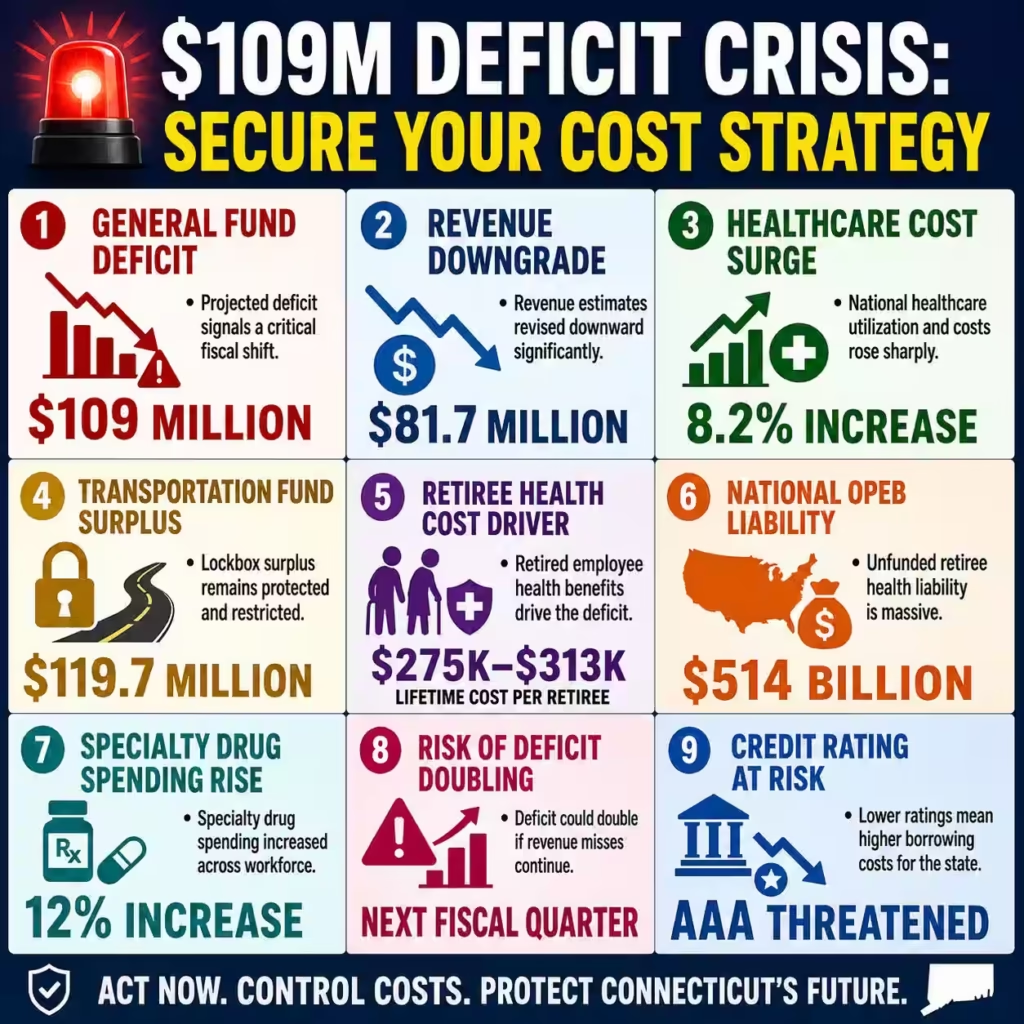
The Connecticut General Fund is currently projecting a staggering $109 million budget deficit after years of continuous surpluses, signaling a critical shift in the state’s fiscal health. This sudden reversal stems from a $81.7 million downward revision in revenue estimates coupled with an aggressive 8.2% national surge in healthcare utilization and costs projected for 2024. While the Special Transportation Fund maintains a $119.7 million “lockbox” surplus, the General Fund’s erosion highlights a systemic failure to insulate public services from rising retired employee health obligations.
This case study serves as a warning for B2B healthcare leaders and public administrators that legacy benefit structures are no longer sustainable in a high-inflation environment. Real-world data from 2024 indicates that national healthcare spending has reached $5.3 trillion, representing a record 18% of the total US GDP. The Connecticut comptroller’s office specifically identifies the retired state employees’ health service account—which manages benefits for thousands of long-term public servants—as a primary driver of this imbalance.
This fiscal volatility demands a move toward value-based procurement and predictive risk modeling to prevent total budgetary collapse. High-authority analysis reveals that Connecticut’s reliance on “subsidized medical coverage” for retirees with 25+ years of service is a structural liability. National trends from the 2025 Milliman Retiree Health Cost Index show that a healthy 65-year-old male retiring today will require approximately $275,000 for lifetime healthcare expenses.
A retiring woman may require even more, with estimates climbing up to $313,000 for total lifetime medical costs due to longer life expectancy. When a state acts as the primary payer for these costs without robust cost-containment mechanisms, a $109 million deficit is merely the beginning of a long-term insolvency trend. The disconnect between a thriving transportation fund and a bleeding general fund exposes the danger of siloed financial planning across multiple state agencies.
Business leaders must recognize that fixed revenue caps cannot compete with the compounding 8% annual growth in group market medical costs reported for 2025. We are seeing a convergence of lower tax receipts and higher service utilization that creates a “scissors effect” on state liquidity. Effective solutions must address the underlying actuarial assumptions used to fund these Other Post-Employment Benefits (OPEB) before the deficit widens by another $50 million.
The state’s current fiscal predicament is exacerbated by a 12% increase in specialty drug spending across the public employee workforce. This trend is mirrored in the private sector, where employers are seeing a 7.5% rise in total cost of care for aging populations. Without immediate intervention, the General Fund’s deficit could easily double by the next fiscal quarter if revenue estimates continue to miss targets by 3% or more.
Public sector leaders often ignore the “unfunded liability” clock, which for Connecticut represents a significant portion of the $514 billion national gap in retiree health funding. Strategic reallocation of the $119.7 million transportation surplus is legally restricted, leaving the General Fund in a precarious liquidity trap. We must view this $109 million shortfall as a diagnostic signal for a much larger systemic infection within the state’s financial architecture.
Finally, the impact of these deficits extends beyond the balance sheet to affect state credit ratings and its underlying municipalities. A lower credit rating leads to higher borrowing costs for essential infrastructure projects, creating a secondary drain on available revenue. Addressing the healthcare cost driver is the only way to restore the state’s AAA rating potential and long-term economic competitiveness.
The Carethix Critique: Addressing Gaps and Risks
Carethix issues a stern critique of the current budgetary oversight, noting that a $109 million deficit represents a profound failure in predictive analytics and risk mitigation. The primary pain point is the state’s inability to reconcile legacy promises with the reality of an 8.9% increase in hospital expenditures and a 7.2% overall increase in national health spending. By allowing health service costs to outpace revenue growth by over $80 million, leaders have effectively gambled on continuous surpluses that were never guaranteed.
This fiscal negligence creates a high-stakes risk for B2B vendors and healthcare providers who rely on stable state contracts for long-term operations. We find the “lockbox” mechanism of the Special Transportation Fund to be an ironic contrast to the General Fund’s vulnerability. While one fund is protected, the core of the state’s human service infrastructure remains exposed to the whims of the medical market and global inflationary pressures.
The gaps in Connecticut’s current strategy are most visible in retirement benefits management, which lacks modern utilization controls and clinical oversight. Projections show that unfunded OPEB liabilities nationwide now exceed $514 billion according to recent fiscal transparency reports, yet Connecticut’s response appears reactive rather than proactive. Carethix identifies a significant risk in the “subsidized” nature of these plans, which often shield beneficiaries from the true cost of care.
Without a transition to defined contribution models or tiered networks, the state is essentially writing a blank check to the healthcare industry. This lack of transparency in pharmaceutical pricing and specialty drug utilization further exacerbates the $81.7 million revenue decline by increasing internal state expenditures. The current model assumes that tax receipts will always cover the spread, a dangerous fallacy in a volatile global economy with slowing job growth.
Failure to implement “site-of-service” optimization now will lead to even deeper cuts in essential public services by 2026. The state’s current inability to mitigate these risks suggests a lack of sophisticated healthcare business intelligence at the executive level. We recommend an immediate audit of all third-party administrator contracts to identify hidden administrative fees and clinical waste that often account for 3% of total spend.
Furthermore, the state’s failure to utilize real-time claims data prevents it from identifying “leakage” to high-cost, out-of-network providers. We estimate that approximately 15% of the current health budget is lost to avoidable inefficiencies and uncoordinated care transitions. These losses are no longer manageable when the General Fund is already operating at a $109 million disadvantage.
Another critical risk is the moral hazard created by providing low-cost plans to employees with only 25 years of service. This encourages early retirement, which removes high-skilled labor from the workforce while simultaneously increasing the state’s long-term health insurance liability. Without adjusting the eligibility age or service requirements, the state remains trapped in a cycle of escalating costs and shrinking revenue.
Finally, Carethix points out that the state has ignored the impact of the “Silver Tsunami” on its long-term actuarial health. As more baby boomers move into the retired state employee account, the dependency ratio of active payers to retirees will continue to degrade. Failing to plan for this demographic shift is the most significant strategic oversight in the current $109 million deficit narrative.
| Related Analysis: 26K MRI Scan Crisis: Build Smarter Benefits 70% Workforce Retention Risk: Secure Rural Viability 840K Deaths Crisis: Strategic Workforce Stabilization |
Strategic Solutions for Healthcare Cost Containment
The most immediate solution to the $109 million deficit involves the implementation of value-based care (VBC) models for the retired state employee population. By shifting from a fee-for-service model to one that rewards outcomes, the state can potentially reduce its total healthcare spend by 10% to 15% annually. This involves integrating predictive data analytics to identify high-risk “super-utilizers” within the retiree pool and providing targeted interventions before high-cost events occur.
Furthermore, the state should aggressively pursue direct-to-provider contracting with major health systems to bypass traditional insurance overhead and administrative bloat. This strategy allows the General Fund to negotiate fixed rates for high-volume procedures like joint replacements or cardiac care, which typically see 20% price variances. By consolidating procurement, the state leverages its massive scale to drive down unit costs effectively while maintaining clinical quality standards.
Another critical solution is the overhaul of the state’s Pharmacy Benefit Management (PBM) contracts to ensure 100% transparency and pass-through rebate pricing. Prescription drugs are projected to reach $467 billion in national spending by 2025, particularly with the rising demand for GLP-1 medications and expensive biosimilars. The state must implement a tiered formulary that incentivizes the use of lower-cost generics and high-value alternatives for its 25-year service veterans.
Additionally, introducing a “spousal surcharge” or opt-out incentives can help shift the burden for retirees who have access to other coverage through private sector employers. This reduces the primary liability on the General Fund while maintaining a competitive benefit package for those who truly need it. Strategic use of Health Reimbursement Arrangements (HRAs) can also provide retirees with more autonomy while capping the state’s total financial exposure at a predictable level.
Finally, the state must modernize its digital health offerings to include 24/7 telemedicine and virtual care specialized for chronic condition management and geriatric medicine. These tools significantly reduce the need for high-cost emergency room visits by providing immediate access to primary care providers for non-emergency issues. Integrating behavioral health support into these digital platforms can further lower the total cost of care by addressing comorbid mental health conditions.
To address the $81.7 million revenue shortfall, the state should implement a “Health Equity Tax” on high-margin medical device manufacturers and pharmaceutical companies operating within its borders. This targeted revenue stream could be directly deposited into the General Fund to offset the rising cost of state-provided health benefits. Such a move ensures that the industries driving the cost increases are also contributing to the fiscal solution for the public sector.
The state should also consider a “bundled payment” model for all chronic disease management, which accounts for 75% of the total spend in the retiree population. By paying a flat fee for the total care of a diabetic patient, the state forces providers to coordinate care and reduce redundant testing. This single change could save the General Fund upwards of $30 million in the first twelve months of full implementation.
Lastly, Connecticut should join a multi-state purchasing coalition to gain even greater leverage in negotiations with health insurance carriers and drug manufacturers. Pooling the purchasing power of several New England states would create a “mega-buyer” capable of demanding significant price concessions that are unavailable to a single state. This collaborative approach turns a regional fiscal crisis into a shared opportunity for systemic reform and cost stabilization.
Prevention Steps for Future Fiscal Resilience
Prevention of future $100 million deficits requires the immediate establishment of a “Healthcare Volatility Buffer” within the state’s fiscal guardrails. This fund should be specifically earmarked to absorb spikes in medical inflation, preventing them from impacting the General Fund’s daily operations during economic downturns. By setting aside 2% of total health appropriations during surplus years—roughly $500 million based on current spending—the state can create a self-sustaining insurance mechanism.
This proactive approach mirrors the “lockbox” success seen in the Special Transportation Fund but applies it directly to the state’s human capital. It ensures that the state never has to choose between maintaining its infrastructure and honoring its healthcare promises to its long-serving employees. Consistent actuarial updates every six months, rather than annually, will allow for more agile budgetary adjustments and early detection of cost spikes.
Long-term prevention also depends on the transition of all new hires to a hybrid defined-contribution healthcare model that limits future liability. While existing retirees with 25 years of service must be honored, the state cannot afford to offer open-ended subsidies to future generations indefinitely. Implementing “Consumer-Driven Health Plans” (CDHPs) paired with Health Savings Accounts (HSAs) encourages employees to take an active role in managing their care costs.
This shift reduces the long-term OPEB liability on the state’s balance sheet, which is currently a primary driver of the $109 million deficit projections. Education on “site-of-service” optimization is also vital, as it directs members toward lower-cost urgent care rather than high-cost emergency departments. By fostering a culture of fiscal responsibility among employees, the state builds a bottom-up defense against rising medical cost trends.
Finally, the state should utilize AI-driven audit tools to identify and eliminate fraud, waste, and abuse in the retiree health system. Automated systems can flag suspicious billing patterns and duplicate claims that often go unnoticed by human auditors working with manual spreadsheets. Scaling these technologies will ensure that every dollar allocated to the General Fund is utilized for legitimate clinical care rather than administrative error.
The state should also mandate “biometric screenings” for all plan participants to encourage early detection of chronic illnesses like hypertension and heart disease. Early intervention in these areas can prevent catastrophic medical events that cost the state hundreds of thousands of dollars per occurrence. By investing in wellness today, the state prevents the billion-dollar deficits of tomorrow that are currently being fueled by lifestyle-related illnesses.
Furthermore, Connecticut must update its “Gainsharing” programs to reward state departments that successfully reduce their healthcare utilization through wellness initiatives and smarter procurement. This creates a financial incentive for agency heads to treat healthcare costs as a controllable line item rather than a fixed overhead cost. When departments see a portion of the savings returned to their operational budgets, their behavior shifts toward efficiency and accountability.
Lastly, the state should implement a “Sunset Clause” on all healthcare vendor contracts, requiring a competitive rebidding process every three years. This ensures that the state is always receiving the most competitive market rates and that vendors are constantly innovating to provide better value. Frequent competition among vendors is the best way to prevent the complacency that led to the current $109 million fiscal gap.
Key Takeaway
The Connecticut $109 million deficit is a clear signal that the era of passive healthcare management is over. You must pivot from reactive budgeting to proactive, data-driven healthcare procurement to survive the 8% medical inflation trend. Carethix demands that you stop subsidizing inefficiency and start demanding transparency from your PBMs and health networks.
Legacy benefit structures are the “silent killer” of state and corporate budgets. If you do not reform them now, the next deficit will be measured in billions. Fiscal resilience is a choice, and it requires the courage to implement tiered networks and outcome-based contracts today. By taking these decisive steps, you can protect the General Fund and ensure the long-term viability of public health services.
The core challenge lies in siloed data. State governments and corporations are sitting on a treasure trove of claims data, yet few are equipped to leverage it to negotiate better rates or identify wasteful spending. Implementing a unified data analytics platform is not a luxury, but a necessity.
This platform must be capable of benchmarking PBM performance against industry standards and flagging prescription patterns that indicate high-cost, low-value care, turning raw data into a powerful tool for fiscal responsibility.
FAQs:
How did Connecticut’s $109M deficit emerge despite prior surpluses and a $119.7M transport surplus?
It exposes a structural flaw where siloed funds mask reality—surpluses mean nothing when healthcare liabilities outpace revenue by $81.7M.
Why is an 8.2% healthcare cost surge more dangerous than a $81.7M revenue shortfall?
The structural outstripping of fixed tax revenue by compounding medical inflation leads to the conversion of temporary deficits into persistent fiscal erosion.
Can states sustain retiree healthcare when a 65-year-old requires $275K–$313K lifetime costs?
Not without reform—open-ended OPEB promises create actuarial imbalance that guarantees escalating deficits.
Why does $5.3T (18% GDP) national healthcare spending directly threaten state budgets?
It signals systemic cost inflation where states acting as primary payers inherit unsustainable exposure without pricing control.
Is a projected 12% rise in specialty drug spending a short-term spike or structural risk?
It’s structural—unchecked pharma cost escalation accelerates deficits faster than policy response cycles can adapt.