Strengthen rural healthcare stability with proven strategies achieving 70% workforce retention and long-term system viability.
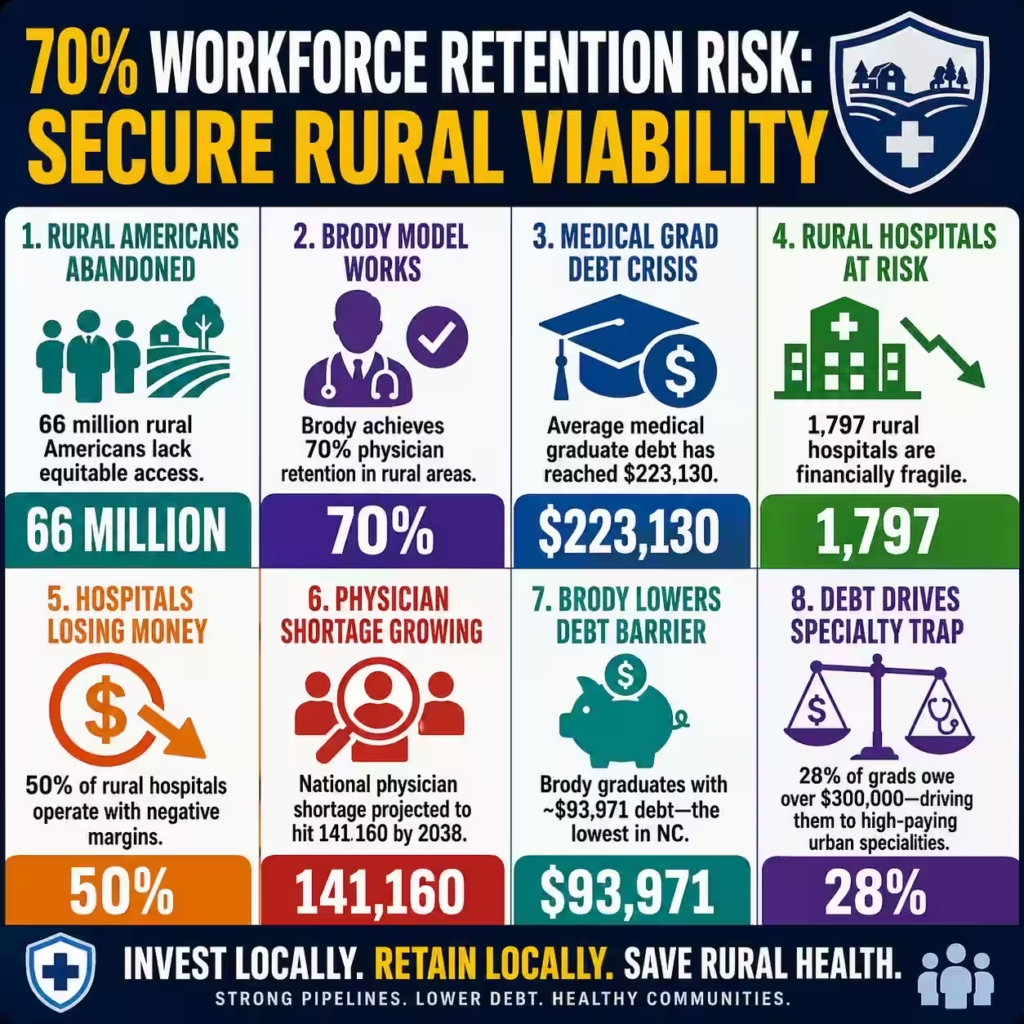
Dr. Michael Waldrum, CEO of ECU Health, recently stood before the House Ways and Means Committee to declare that 66 million rural Americans are being systematically abandoned by inflexible federal healthcare policies. He presented a staggering data point: the Brody School of Medicine achieved a 70% retention rate for physicians in rural environments by intentionally restructuring the education-to-practice pipeline. This success stands in stark contrast to a national landscape where 1,797 rural community hospitals are struggling against an average medical graduate debt that has climbed to $223,130 in 2025.
The pain point is clear: “one size fits all” federal reimbursement and education models are bleeding rural systems of both talent and capital. While national physician shortages are projected to reach 141,160 by 2038, ECU Health has proven that local investment in rural residency programs creates a direct, measurable return on community health. This article analyzes how you can replicate these high-yield retention models to safeguard your system’s financial and clinical viability.
Current market data suggests that the financial vulnerability of rural health is no longer a localized issue but a systemic risk to the U.S. economy. Since 2005, over 200 rural hospitals have closed their doors, leaving vast “healthcare deserts” that decimate local labor productivity and property values. ECU Health’s model challenges the traditional eight-year U.S. medical education track, which is significantly slower and more expensive than the six-year European equivalents.
By lowering the average graduate indebtedness to approximately $93,971—the lowest in North Carolina—Brody has removed the primary barrier to primary care residency. This strategic debt reduction acts as a powerful recruitment tool, ensuring that 70% of graduates remain in the region to serve sicker, older, and poorer populations. You must recognize that without these targeted pipeline interventions, the escalating cost of physician labor will eventually bankrupt the rural safety net.
Further compounding this crisis is the reality that 50% of America’s rural hospitals are now operating with negative margins as of 2024, the highest percentage ever recorded. In non-expansion states, this figure rises to 55%, leaving 418 hospitals across 16 states immediately vulnerable to closure. The Brody School of Medicine mitigates this by ranking in the top 10% of U.S. medical schools for graduates practicing in underserved areas, effectively subsidizing the local workforce.
By maintaining a tuition rate that is 73% lower than the national average for private medical schools, ECU creates a sustainable pathway for students from low-income backgrounds. Your organization must analyze these metrics to understand that workforce retention is a mathematical byproduct of early-stage financial intervention. High-authority leadership requires a shift from passive recruitment to active, debt-mitigated pipeline architecture.
Carethix Critique: The Structural Gaps in the “One Size Fits All” Doctrine
The testimony provided by Dr. Waldrum highlights a critical failure in current legislative frameworks: the refusal to differentiate between high-volume urban centers and low-volume rural safety nets. When federal policy mandates identical compliance and technology standards across all systems, it ignores that rural hospitals often operate on razor-thin margins with an unfavorable payer mix of 72% Medicare and Medicaid. This regulatory burden creates a “compliance tax” that disproportionately drains resources from clinical care into administrative overhead.
Furthermore, the 11% decline in practicing rural family physicians between 2017 and 2023 indicates that current federal incentives are failing to counteract the gravitational pull of urban specialty markets. You are facing a market where 400 rural hospitals are currently at risk of closure due to these exact structural gaps. Risks are further compounded by the “debt-to-specialty” trap, where 28% of the Class of 2025 graduates with over $300,000 in debt, forcing them into high-paying urban specialties.
This creates a workforce vacuum in the very areas where 15% fewer primary care providers exist per capita compared to metropolitan regions. Current Medicare reimbursement rates, while adjusted for some low-volume hospitals, still do not account for the total cost of maintaining 24/7 emergency services in communities with declining populations. The gap between commercial reimbursement—which sits at roughly 196% of Medicare rates—and the actual cost of rural delivery is widening, leaving nonprofit systems to absorb the deficit.
We critique the current “value-based” models as being inherently biased toward urban data sets, effectively punishing rural providers for the social determinants of health they cannot control. You must address these gaps now, or risk a total collapse of the regional hub-and-spoke delivery model. We also identify a glaring lack of support for the “Whole-of-Person” retention framework, with only 19% of national initiatives exclusively focusing on rural-specific workforce needs.
Most recruitment programs ignore the “Community/Place” domain, which accounts for 60% of long-term physician satisfaction in non-metropolitan areas. The current model prioritizes short-term sign-on bonuses over structural debt relief, a strategy that results in a 45% turnover rate within the first three years of rural practice. This “churn-and-burn” cycle costs health systems an average of $1.2 million per physician departure in lost revenue and replacement costs.
Your system cannot afford to ignore these structural flaws in the national healthcare architecture. To survive, you must move beyond federal policy dependence and build localized, resilient workforce strategies. The current landscape demands that you decouple your operational success from shifting political tides in Washington.
| Related Analysis: 80% APOL1 Expert Analysis: Early Detection Win Model Pancreatic Cancer 24 Visits: Smart Triage Advantage 34-Case Salmonella Crisis: Smarter Buyer Protection |
Strategic Business Solutions for Rural Market Stability
To counter the $223,130 debt barrier, your health system must adopt the “Debt-Free Residency Pipeline” model popularized by high-authority institutions like Brody. This involves establishing local philanthropic endowments specifically earmarked for tuition forgiveness in exchange for five-year rural practice commitments. By lowering the entry price for medical education, you shift the financial incentive from “debt repayment” to “community investment.”
You should also pursue “Advanced Task Shifting” by aggressively integrating Nurse Practitioners (NPs) and Physician Assistants (PAs) into primary care roles to offset the 141,000-physician shortage. Data shows that 74% of stakeholders support these models, as the supply of rural NPs is projected to exceed demand over the next decade. Financial stabilization requires a shift toward the “Rural Emergency Hospital” (REH) designation for your most vulnerable facilities.
Early 2026 data shows that hospitals converting to REH status saw median total margins improve from -17.9% to +7.4%, a massive 25.3 percentage point increase. This designation provides a $3.2 million annual facility subsidy plus a 5% Medicare reimbursement add-on for outpatient services. You must also implement “Digital Health Ecosystems” to bridge the geographic isolation that drives up the cost of care for chronic diseases.
Telemedicine and remote patient monitoring can reduce the 424 rural hospital service cuts seen in chemotherapy and maternal care by providing specialist oversight to local generalists. By leveraging these technologies, you can maintain a “hub-and-spoke” efficiency that keeps patients within your system while lowering the overhead of physical specialty clinics. Furthermore, you should explore the “Rural Health Transformation” (RHT) funding pools, which are allocating $50 billion over the next five years to support sustainable access points.
This allows your system to coordinate operations with high-quality regional hubs, sharing the $150,000 annual cost per residency student through General Assembly-funded “Select Teaching Practices.” Integrating these hubs into your network ensures that 50% or more of training time is spent in rural settings, which is proven to increase the commitment to rural primary care. Negotiate commercial contracts that recognize the “safety net” value of your network, aiming for a percentage of Medicare FFS that reflects your 30-40% higher operating costs.
These solutions are not merely clinical—they are financial imperatives for the next fiscal cycle. You must act decisively to secure your market share in an increasingly consolidated landscape. Failure to adapt your business model now will cause an irreversible loss of community clinical capacity.
Prevention Methods for Future Healthcare Policy Disruption
Preventing future system collapse begins with “Policy Agnosticism” in your long-term capital planning. You should avoid over-reliance on temporary federal grants and instead focus on building “Integrated Supply Chains” that lower the cost of essential medicines by 15-20% through regional cooperatives. Establishing a “Rural Residency Consortium” with neighboring systems can share the $100,000+ annual cost of training per resident, creating a larger talent pool for the entire region.
This collaborative approach prevents the “poaching” of talent between neighboring rural counties and stabilizes the local labor market. You should also diversify your revenue streams by offering B2B occupational health services to local agricultural and manufacturing sectors, creating a stable, commercial-payer base outside of government programs. To prevent the total erosion of maternal and surgical services, you must implement “Hybrid Clinical Rotations” where specialists from urban hubs spend 20% of their time in rural areas.
This maintains clinical competency in local staff and ensures that high-risk patients can be identified and transferred before they become emergency liabilities. You must also invest in “Predictive Analytics for Population Health” to identify the 5-10% of your patient population that drives 50% of your costs. By intervening early in chronic disease cycles, you prevent the high-cost hospitalizations that currently threaten your solvency.
Finally, your board must adopt “Community-Centric Governance,” ensuring that 30% of leadership comes from the local community to maintain trust and drive patient volume. Prevention is not a one-time event; it is a continuous process of de-risking your clinical and financial operations against a volatile federal landscape. Additionally, you must monitor the 820+ bills enacted in 2025 across 49 states that address health workforce maldistribution.
States like Texas and Minnesota are now appropriating millions for workforce research, providing a roadmap for your own internal data analysis. By creating a “Health Professions Workforce Coordinating Council” within your system, you can project supply and demand needs for the next 10 years with 90% accuracy. This proactive stance allows you to adjust your “residency mix” before shortages reach critical levels.
Investing in short-term housing for medical students can further increase commitment rates by fostering community integration, a factor that 72% of rural HPSAs currently lack. Robust prevention requires a fusion of state-level policy alignment and hyper-local operational agility. You must build the future you want, or be forced to accept the one federal policy dictates.
Carethix Key Takeaway
The era of “one size fits all” healthcare is dead. Survival now depends on your ability to localize your workforce pipeline and diversify your payer mix. ECU Health’s 70% retention rate is not a miracle—it is the result of a deliberate, data-driven attack on the $223,130 physician debt crisis. You must stop waiting for a federal “Rural Marshall Plan” and start building a self-sustaining regional ecosystem that values primary care as a strategic asset rather than a cost center.
Implement debt-forgiveness, adopt the REH designation, and use digital health to bridge the gap between urban quality and rural access. If you fail to act on these structural reforms, your system will be the next statistic in the 400-hospital “at-risk” column. Success in the rural market belongs to the bold, the local, and the financially resilient.
FAQs:
Why are 66M rural Americans still underserved despite federal healthcare spending growth?
Because “one-size-fits-all” reimbursement ignores rural cost structures, policymakers must shift to location-adjusted, outcome-linked funding that reflects real delivery economics.
How does the $223,130 average medical debt in 2025 distort rural physician supply?
This debt structurally pushes graduates toward urban specialties, so systems must replace sign-on bonuses with binding debt-forgiveness pipelines tied to rural service.
Why are 50% of rural hospitals operating at negative margins in 2024 despite value-based care models?
Because current models are calibrated to urban data, leaders must redesign metrics around rural population risk and low-volume sustainability to avoid systemic mispricing.
What explains the 70% rural physician retention success at ECU Health versus national shortages of 141,160 by 2038?
It proves retention is engineered—not accidental—requiring early-stage financial intervention and localized training pipelines rather than late-stage recruitment spending.
Why does a 45% physician turnover within 3 years cost $1.2M per exit for rural systems?
Because short-term incentives ignore long-term community integration, systems must invest in “whole-of-person” retention frameworks to eliminate costly churn cycles.