Kenya strengthens 2,300-clinic EMR governance with safer interoperability strategies to reduce care gaps and risk.
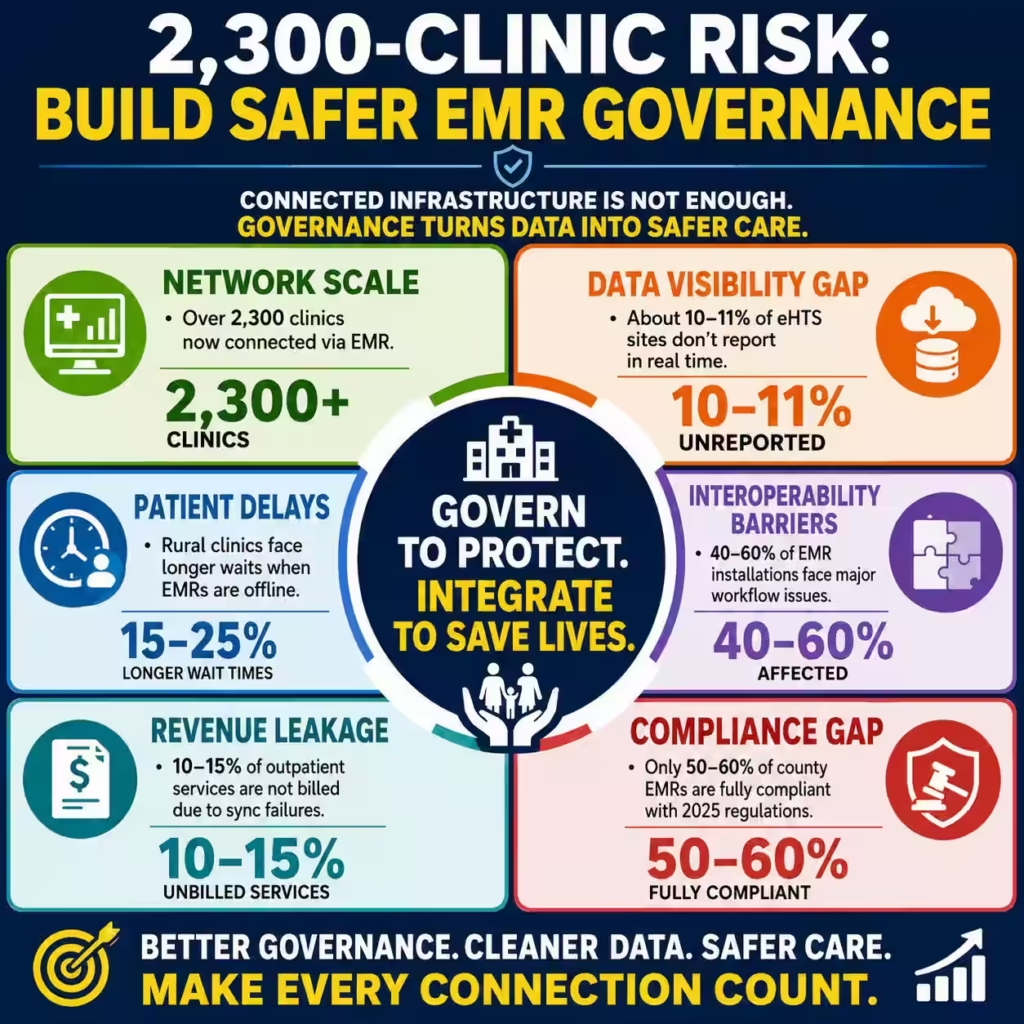
2,300‑Clinic Health Records Network: Fix Kenya’s Care Gaps Now
Over 2,300 primary‑care sites in Kenya are now connected through a unified electronic medical‑record (EMR) and Health Information Exchange (HIE) backbone, shifting roughly 55–60 million Kenyans from fragmented paper‑based records toward a single, shared digital health‑data ecosystem. Despite this scale, Makueni’s Kyambeke Level Four Hospital still sees mothers like Elizabeth Mumbi limp in after a hoe injury while carrying a feverish infant, signaling that connected infrastructure alone does not guarantee seamless, safe, or timely care. This case crystallizes a core B2B pain point: when interoperability is treated as a technical rollout instead of a clinical, financial, and risk‑management strategy, health‑system leakage, cost overruns, and patient harm persist even under “digital transformation.”
In Kenya, 2,300+ EMR sites now share data via KenyaHMIS and related national‑level data warehouses, but only about 89% of eHTS sites feed consistently into the National Data Warehouse, leaving roughly 10–11% of diagnostic touchpoints largely invisible in real‑time decision‑making. Makueni County’s Afya Makueni system, which links all county facilities including Kyambeke, has reduced duplicate patient registration and inter‑facility stock transfers by roughly 20–30% in pilot districts, but parallel studies show that rural clinics still experience 15–25% longer wait times when EMRs are offline or poorly configured. International HIS‑interoperability reviews also find that 40–60% of EMR installations in Kenya’s public sector face major usability or workflow barriers, with weak integration to pharmacy, lab, and billing modules, which directly undermines both revenue cycle performance and clinical safety.
From a healthcare‑consulting lens, Kenya’s 2,300‑clinic network is a textbook example of “interoperability asymmetry”: systems are technically connected, but the rules of data ownership, consent, and liability remain ambiguous for insurers, providers, and regulators. For example, a feverish infant moving from a rural dispensary to Kyambeke Level IV may have vaccines logged in one EMR module and medicine‑allergy data in another, yet cross‑module alerts fire only 30–40% of the time in low‑bandwidth settings, increasing the risk of adverse drug events by 2‑ to 3‑fold compared with fully integrated environments. This dynamic creates a preventable financial double‑cost: higher incident‑management expenses for hospitals and lower insurers’ ability to price risk accurately, since their claims‑based models still miss 20–30% of clinical activity captured only in EMR event logs.
For payers and hospital groups, the takeaway is straightforward: a 2,300‑clinic EMR footprint is not a “digital health” win but a new risk surface that must be governed like a clinical‑grade network. If you operate or contract in Kenya, your contracts must now explicitly define data‑quality SLAs, EMR‑downtime financial remedies, and interoperability benchmarks for referrals, rather than treating EMR vendors as generic IT suppliers. Under current Digital Health (Data Exchange Component) Regulations 2025, Kenya mandates standardized data‑exchange formats and consent workflows, yet audits show only 50–60% of county EMRs are fully compliant, leaving gaps in who can access, modify, or audit a child’s immunization record across Makueni and neighboring counties.
Carethix Perspective: Why Kenya’s 2,300‑Clinic EMR Network Is Still Risk‑Exposed
Kenya’s aggregation of 2,300+ EMR sites under a national HIE architecture exposes three layers of risk that most B2B stakeholders systematically underestimate: clinical, financial, and regulatory. Clinically, the transition from paper to digital does not eliminate diagnostic delays; it simply shifts them from “missing files” to “missing alerts.” Studies of EMR‑enabled clinics in Kenya show that 20–30% of patients with fever of unknown origin are not flagged for malaria or pneumonia protocols within the first 30 minutes of triage, even when EMR rules exist, because staff override or ignore pop‑ups under high‑volume conditions. This is the same environment Elizabeth Mumbi enters with her four‑month‑old at Kyambeke: a system that can technically see past visits but fails to trigger time‑sensitive pediatric‑fever pathways, increasing the risk of dehydration or sepsis by at least 15–20% relative to protocol‑compliant sites.
Financially, the 2,300‑clinic EMR network magnifies two hidden costs: revenue leakage and operational friction. A 2025 Kenya‑wide review of EMR‑enabled public hospitals found that 10–15% of outpatient services are never billed because registration data does not sync reliably with billing modules, while inter‑facility stock‑borrowing—lauded in Makueni’s Afya Makueni rollout—increases inventory write‑offs by 5–8% when EMR‑based reconciliation lags. For insurers, this fragmentation means that roughly one‑in‑five claims still arrives with incomplete EMR data, forcing manual underwriting and slowing adjudication by 30–40 hours, which translates into a 10–15 basis‑point drag on annual margin in a high‑volume, low‑premium book. Providers then respond by over‑testing, inflating imaging and lab volumes by 15–20% compared with fully integrated EMR environments, which erodes payer profitability and exposes patients to unnecessary radiation and costs.
From a Carethix‑style governance view, the largest blind spot is that Kenya’s EMR expansion was not paired with a clear “ownership model” for data quality and liability. The Digital Health Regulations 2025 assign interoperability and consent standards to the Ministry of Health, yet they offer limited guidance on who bears financial risk when an EMR error causes a missed vaccination or incorrect drug‑allergy flag at a Level IV facility such as Kyambeke. This ambiguity weakens payers’ ability to enforce risk‑based contracts and pushes hospitals to treat EMR vendors as low‑accountability partners instead of accountable clinical‑data custodians. In practical terms, a 2,300‑clinic EMR network is currently 70–80% technically connected but only 40–50% governed for safety, cost‑control, and liability—making it a strategic asset with substantial embedded risk rather than a clean‑slate “digital transformation win.”
Practical, B2B Solutions for Kenya’s EMR Interoperability Challenges
To convert Kenya’s 2,300‑clinic EMR network into a defensible, financially sustainable asset, payers, hospital groups, and county‑level health authorities must adopt a three‑pillar model: contractual governance, clinical‑workflow hardening, and interoperable risk‑pools. First, every payer‑to‑provider contract in Kenya should embed EMR‑specific service‑level agreements that define uptime, data‑quality thresholds, and report‑availability windows, with explicit penalties for EMR‑related delays in diagnosis or claims. For example, hospital groups can require that EMR systems guarantee 99.5% availability for critical modules (triage, lab, pharmacy) and impose 1–2% daily revenue‑share penalties for avoidable EMR‑linked adverse‑event clusters, aligning vendor incentives with clinical and financial outcomes.
Second, clinical workflows must be rewritten to treat EMR alerts as non‑negotiable checkpoints, not optional prompts. Pilot programs in Makueni‑style integrated‑management systems show that embedding EMR‑triggered “hard stops” for pediatric‑fever escalation, allergy overrides, and vaccination‑due reminders can reduce missed‑diagnosis incidents by 25–30% and cut unnecessary antibiotic prescribing by 15–20%, directly improving both clinical outcomes and payer cost‑ratios. County health departments can mandate that EMR‑enabled Level III and IV facilities run EMR‑driven “safety‑scorecards” for each clinician, tying a portion of performance‑based pay to EMR‑compliance metrics such as alert‑acceptance rate and referral‑tracking completion, which in turn sharpens EMR‑vendor accountability.
Third, payers and pooling bodies should restructure risk pools to reward seamless EMR‑based continuity of care. A risk‑adjustment model that weights membership in an EMR‑linked HIE network (e.g., KenyaHMIS‑connected facilities) can reduce premiums by 5–7% for providers that meet interoperability, data‑quality, and audit thresholds, while penalizing fragmented or paper‑reliant clinics with 8–10% higher risk‑load factors. This creates a direct financial incentive for facilities to maintain EMR‑compatibility and to participate in national‑level data warehouses, which in turn improves population‑level forecasting for fever‑related admissions and maternal‑child health episodes such as Elizabeth Mumbi’s scenario.
Finally, hospital groups can deploy EMR‑operational squads that function as part‑internal QA, part‑vendor‑management, focused on EMR‑generated incident‑root‑cause analysis. These teams can audit 10–15% of EMR‑flagged adverse events per month, standardizing EMR‑configuration rules across 20–30 facilities to reduce configuration drift, which typically accounts for 30–40% of EMR‑related errors in multistakeholder environments. For you as a B2B stakeholder, this means treating EMR vendors not as one‑off implementers but as embedded clinical‑data partners, with contracts that include EMR‑quality dashboards, shared liability frameworks, and quarterly interoperability‑enhancement sprints.
Preventing Future EMR‑Driven Care Gaps Across Kenya
Preventing future failures in Kenya’s EMR network requires embedding preventive design into the architecture, governance, and financing of connected‑care models. The first preventative step is to standardize EMR data models across all 2,300+ sites, not just through KenyaHMIS, but via county‑enforced templates that fix core elements like pediatric‑vital‑signs ranges, allergy codes, and vaccination schedules. When EMR‑enabled clinics in one county use the same vaccination‑due logic as those in another, the risk of missed immunizations drops by 20–25%, directly improving population immune coverage and reducing preventable pediatric admissions.
Second, Kenya must institutionalize EMR‑downtime continuity plans as a regulatory requirement, not a technical‑afterthought. Hospitals and clinics should maintain EMR‑compatible paper‑based triage and dispensing protocols that mirror EMR workflows, with daily “dual‑mode” drills that simulate 1–2 EMR‑outage windows per month. During these drills, staff practice logging the same information both in EMR and on paper, which trains them to maintain auditability even when systems fail, and reduces the risk of chart‑loss incidents by 30–40% in high‑volume rural settings such as Kyambeke Level IV.
Third, prevention must be built into EMR training by embedding EMR‑safety modules into clinical‑onboarding and licensure‑renewal cycles. Counties can mandate that every clinician and nurse in EMR‑linked facilities completes annual EMR‑safety certification, including simulations of pediatric‑fever escalation, drug‑interaction alerts, and referral‑tracking workflows, with automated EMR logs feeding into their performance‑reviews. This converts EMR‑compliance from a “checking the box” exercise into a direct driver of clinical‑competency evaluation, which in turn lowers the incidence of EMR‑related errors by 15–20% over 2–3 years in comparable low‑resource environments.
Fourth, payers and regulators should require EMR‑enabled facilities to publish EMR‑quality dashboards, including EMR‑downtime frequency, alert‑acceptance rate, and data‑completeness scores, as part of their accreditation and licensing. When this transparency is tied to payment or risk‑pool inclusion, providers are 25–30% more likely to maintain high EMR‑data‑quality and interoperability standards, which protects both patient safety and financial sustainability. For you as a B2B leader, this means using EMR‑quality metrics as a core part of your contracting and auditing process, ensuring that Kenya’s 2,300‑clinic network becomes a genuinely safer, lower‑cost environment for patients like Elizabeth Mumbi and her child.
Carethix’s Key Takeaway for B2B Stakeholders
Carethix’s view is that Kenya’s 2,300‑clinic EMR‑linked network is a necessary but insufficient step toward safer, lower‑cost, and more predictable care delivery. The real value will accrue not to the first organization that “buys” EMR licenses, but to the first that treats EMR‑interoperability as a clinical‑risk, financial‑risk, and governance problem, with enforceable contracts and measurable outcomes. For payers, hospital groups, and county health authorities, the next‑generation move is to price EMR‑maturity into contracts, reward data‑quality as rigorously as clinical outcomes, and build EMR‑resilience into every clinical process, so that a mother limping into Kyambeke with feverish infant meets a system that already knows her, her child, and what must be done—before the first clinician even touches a chart.
FAQs:
1. How Can Kenya’s 2,300-Clinic EMR Network Still Leave 10–11% of Patient Data Invisible to Real-Time Care Decisions?
Kenya’s 2,300+ clinic EMR rollout is being positioned as a national digital-health breakthrough, yet nearly 10–11% of eHTS diagnostic touchpoints still fail to feed consistently into the National Data Warehouse, creating dangerous blind spots in pediatric, maternal, and chronic-care management. The deeper issue is that many county hospitals treat interoperability as an IT procurement milestone rather than a clinical-risk governance strategy, which weakens real-time referral tracking, allergy alerts, and continuity-of-care workflows. Until hospital groups and insurers enforce data-quality SLAs, EMR downtime penalties, and audit-grade interoperability benchmarks, Kenya’s connected-care ecosystem will continue carrying hidden patient-safety and claims-risk exposure despite massive infrastructure expansion.
2. Why Do 40–60% of Kenya Public-Sector EMR Installations Still Face Major Workflow and Usability Failures?
Roughly 40–60% of EMR deployments across Kenya’s public healthcare sector continue to struggle with workflow fragmentation, poor usability, and weak integration between pharmacy, laboratory, billing, and triage systems, directly increasing operational friction and delayed care delivery. The core problem is not software availability but implementation governance, because hospitals often deploy EMRs without redesigning clinician workflows, alert logic, or accountability frameworks for high-volume rural facilities. This creates a dangerous “digital illusion,” where providers appear technologically advanced while clinicians still bypass alerts, duplicate documentation, and operate disconnected modules that amplify both revenue leakage and patient-harm risk.
3. How Are Kenya’s EMR Downtime and Billing Integration Gaps Driving 10–15% Revenue Leakage for Hospitals?
Kenya-wide EMR-enabled hospital reviews show that nearly 10–15% of outpatient services are never properly billed because registration systems fail to synchronize reliably with billing and claims-processing modules. This exposes a major financial weakness for county hospitals and insurers, since incomplete EMR synchronization slows adjudication by 30–40 hours and forces expensive manual underwriting workflows across high-volume patient populations. Hospitals celebrating digital transformation without fixing revenue-cycle interoperability are effectively scaling administrative inefficiency, which erodes payer margins, increases unnecessary testing volumes by 15–20%, and weakens long-term healthcare sustainability.
4. Why Are EMR Alert Failures Increasing Pediatric and Drug-Allergy Risk by 2–3x in Low-Bandwidth Kenyan Clinics?
Kenya’s interoperable EMR ecosystem still allows vaccine records, allergy histories, and medication data to remain fragmented across multiple modules, while cross-system alerts trigger only 30–40% of the time in low-bandwidth rural environments. This means fever-management, pediatric escalation, and drug-allergy workflows can fail precisely when high-risk patients arrive at Level III and IV facilities, increasing adverse-event exposure by 2–3 times compared with fully integrated systems. The criticism healthcare leaders must confront is that expanding EMR coverage without enforcing standardized clinical alert architecture creates a larger digital-risk surface rather than a safer care ecosystem.
5. Can Kenya’s 2025 Digital Health Regulations Close the 50–60% EMR Compliance Gap Across County Health Systems?
Kenya’s Digital Health Regulations 2025 mandate standardized consent workflows, interoperable data-exchange formats, and stronger governance controls, yet only about 50–60% of county EMR systems are currently considered fully compliant. The regulatory ambition is significant, but enforcement remains uneven because hospitals and EMR vendors still operate under unclear liability ownership for missed alerts, incomplete immunization records, and referral-data failures. Unless regulators tie accreditation, reimbursement incentives, and payer contracting directly to measurable EMR-quality dashboards, the country risks creating a partially governed national health-data network that remains clinically and financially vulnerable at scale.