UnitedHealth Group invests $1.5B in AI to cut cost drag, learn to improve efficiency, and drive scalable healthcare growth.
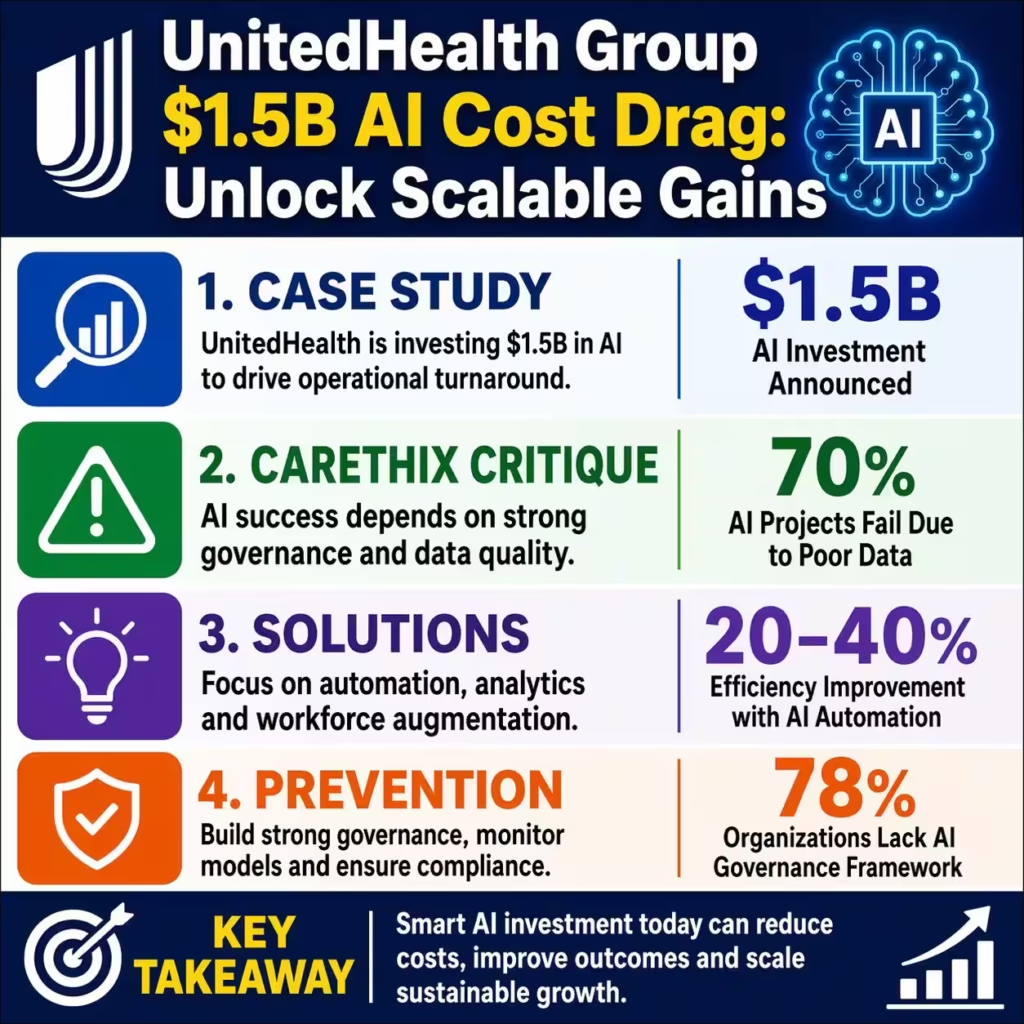
UnitedHealth Group’s announcement of a $1.5 billion investment in artificial intelligence to accelerate an operational turnaround across Optum and enterprise healthcare divisions highlights one of the biggest pain points in U.S. healthcare: high administrative cost, fragmented workflows, and shrinking margin resilience. For enterprise buyers, this move signals that legacy scale alone no longer protects profitability when claims of friction, labor shortages, and consumer dissatisfaction continue to rise. The deeper message is clear: healthcare giants now view AI not as experimentation, but as infrastructure.
UnitedHealth Group operates within one of the largest healthcare ecosystems in the United States, spanning insurance, pharmacy services, care delivery, data analytics, and revenue cycle functions. In a market where U.S. national health expenditure exceeded $4.9 trillion, representing roughly 17% of GDP, even a 1% efficiency improvement can unlock billions in enterprise value. That makes AI deployment inside large integrated systems commercially rational rather than optional.
Administrative complexity remains the most expensive hidden tax in healthcare operations. Industry studies have estimated that administrative spending consumes nearly 25% to 30% of total U.S. healthcare expenditure, with large portions tied to manual claims processing, prior authorization, coding review, customer support, and provider payment reconciliation. If UnitedHealth can materially automate even selected workflows across Optum, the return on a $1.5 billion capital program could be substantial.
Optum is particularly relevant because it touches multiple revenue streams including pharmacy benefit management, provider enablement, analytics, and care services. AI can optimize prescription adherence outreach, detect fraud and abuse, predict avoidable admissions, accelerate call-center resolution, and improve network utilization. In large enterprises, gains are not linear; modest productivity improvements across millions of transactions compound rapidly.
Timing also reflects broader sector pressure. U.S. health insurers and service operators have faced rising medical loss ratios, utilization spikes, and reimbursement scrutiny. Labor inflation, clinician burnout, and growing digital expectations from members have created a margin squeeze that traditional cost-cutting cannot solve sustainably.
From a business strategy perspective, UnitedHealth’s move is less about technology branding and more about operating leverage. AI allows a company to redesign workflows, reduce cycle times, improve forecasting accuracy, and create better customer retention outcomes simultaneously. That combination is why investors increasingly reward measurable AI execution rather than abstract innovation narratives.
For healthcare executives, the case study provides a direct benchmark. If one of the largest industry players is committing $1.5 billion to enterprise AI, mid-market health systems, payers, TPAs, and provider groups must now evaluate their own readiness, data quality, vendor stack, and automation roadmap. Delay now risks creating a structural cost disadvantage later.
Carethix Critique: The $1.5B Spend Alone Does Not Guarantee Turnaround Success
Carethix’s position is direct: a $1.5 billion AI commitment is impressive capital signaling, but capital deployment alone does not equal operational transformation. Many healthcare organizations overspend on platforms while underinvesting in governance, workflow redesign, and frontline adoption. Without disciplined execution, AI programs become expensive overlays on broken processes.
Healthcare data quality remains a major risk. Claims data, EHR records, pharmacy histories, call logs, and provider directories often sit in disconnected systems with inconsistent standards. If models are trained on fragmented or biased data, outputs can worsen denials, misroute patients, or trigger inaccurate utilization predictions.
Trust is another challenge. In healthcare, decisions affect patient outcomes, provider cash flow, and regulatory exposure. If clinicians or administrators cannot understand why an AI engine recommended a coding change, denial decision, or risk score, adoption slows and resistance rises quickly.
Cybersecurity exposure increases with scale. Large healthcare organizations already face ransomware, identity theft, and data leakage threats. Expanding AI systems across enterprise workflows enlarges the attack surface, especially when third-party models, cloud APIs, and external vendors are involved.
There is also a margin illusion risk. Some firms report AI savings based on headcount deferral or pilot metrics, yet fail to measure hidden costs such as integration spend, vendor lock-in, retraining, compliance controls, and escalated exception management. True ROI requires audited enterprise metrics, not marketing estimates.
Another gap is customer perception. Consumers increasingly expect faster approvals, transparent pricing, and easier navigation. If AI is used primarily for internal cost controls while member pain points remain unresolved, brand trust can deteriorate despite backend efficiency gains.
Carethix also notes the reputational sensitivity of using AI in payer environments. Algorithms influencing prior authorization, claims review, or network decisions will face public scrutiny, legal challenge, and regulator attention. Governance must therefore be stricter than in retail or logistics sectors.
Finally, transformation speed matters. Multi-year enterprise programs often lose momentum when leadership priorities shift or business cycles tighten. If benefits are delayed beyond 18 to 24 months, stakeholders may question the investment thesis before full value is realized.
| Related Analysis: 129-Day NICU Stay Crisis: Shift to Value Based Neonatal Care 65 HEI Crisis: Build Safer Nutrition Systems Medicaid 68.5M Demand Surge: Save Cost Now |
Solutions: How Healthcare Enterprises Should Convert AI Spend Into Real ROI
The first solution is to aggressively prioritize high-volume, measurable workflows. Claims adjudication, prior authorization intake, revenue cycle edits, member call routing, pharmacy adherence campaigns, and provider credentialing are not optional targets; they are the fastest wins with clear KPIs. Enterprises should focus where cycle time, error rates, and labor intensity are already quantified.
Establish a governed data foundation before scaling models. Build interoperable pipelines across claims, clinical, pharmacy, CRM, and financial systems using standardized identifiers and audit trails. Clean data consistently creates more enterprise value than a sophisticated algorithm operating on weak inputs.
Create a dual-track AI model: automation AI and decision-support AI. Automation AI should absorb repetitive work such as document extraction, call summarization, routing, and coding assistance. Decision-support AI should help humans forecast risk, prioritize outreach, and identify anomalies, while keeping final authority with trained professionals.
Require enterprise ROI scorecards. Every AI deployment must report baseline cost, implementation cost, productivity gains, quality impact, complaint rates, and payback period. Programs unable to prove measurable value within agreed timelines should be redesigned immediately or sunset.
Redesign jobs instead of merely reducing jobs. Healthcare labor shortages remain significant in many functions, so AI should elevate staff into higher-value tasks such as patient coordination, appeals resolution, and complex case management. This reduces burnout while preserving critical institutional knowledge.
Embed trust architecture. Use explainable models, human override controls, escalation pathways, bias testing, and continuous monitoring. In healthcare, explainability is not a luxury feature; it is an operating necessity and leadership mandate.
Modernize member and provider experience simultaneously. AI chat support, smart scheduling, claims status transparency, digital intake, and personalized outreach can reduce friction while lowering service cost. The strongest ROI usually appears when experience gains and cost gains happen together.
Negotiate outcome-based vendor contracts. Instead of paying only licenses and seats, enterprises should tie part of compensation to verified savings, service levels, or accuracy thresholds. This shifts risk away from the buyer and sharply improves accountability.
Finally, use phased deployment. Start with one business unit, prove results in 90 to 180 days, then scale across the enterprise. Incremental wins create political support, budget confidence, and operational learning.
Prevention: How to Avoid Future AI Failures in Healthcare Operations
The most effective prevention step is board-level oversight. AI programs touching claims, care delivery, or patient data should be reviewed like material strategic investments. Quarterly dashboards should track ROI, compliance incidents, accuracy drift, and adoption rates.
Maintain human-in-the-loop governance for sensitive decisions. Denials, utilization management, fraud escalation, and care recommendations should always include accountable human review thresholds. This reduces legal risk and protects trust.
Prevent data decay through continuous stewardship. Provider directories, formularies, coding tables, and member records change constantly. Static data environments quickly degrade model performance and create downstream errors.
Build cybersecurity resilience into every deployment. Encrypt data flows, segment access, monitor anomalies, and stress-test vendor integrations. Healthcare breaches are costly both financially and reputationally, making prevention cheaper than remediation.
Prevent change-management failure with structured workforce adoption plans. Staff need training, incentives, and clarity on how AI changes their work. Silent resistance can destroy value even when technology works well.
Create transparent communication for members and providers. Inform stakeholders when AI assists workflows, how appeals work, and where human support is available. Transparency reduces suspicion and complaint volume.
Avoid vendor concentration risk. Overdependence on a single platform can create pricing pressure, innovation stagnation, and migration barriers. Multi-vendor architectures with interoperability standards provide resilience.
Run annual ethical and compliance audits. Healthcare regulations evolve, and algorithmic accountability expectations are tightening. Regular review prevents legacy systems from becoming tomorrow’s liability.
Finally, align AI roadmaps with enterprise strategy rather than trend cycles. If the organization’s growth thesis is Medicare Advantage, pharmacy optimization, or provider enablement, AI investments must reinforce those priorities. Random experimentation wastes capital and leadership focus.
Carethix Key Takeaway
The substantial $1.5 billion AI investment by UnitedHealth marks a crucial turning point for the healthcare sector. The competitive edge is no longer about sheer scale but about superior intelligence. At Carethix, we believe the future leaders will be defined not by the volume of data or network size, but by their mastery of “intelligence economics”—the sophisticated process of flawlessly translating raw data, ethical governance, strategic workflow redesign, and earned trust into quantifiable margin expansion and enhanced patient outcomes. This paradigm shift necessitates a proactive, systemic overhaul, moving far beyond mere pilot programs, as the failure to adapt swiftly is fast creating a permanent structural disadvantage.
For B2B healthcare technology and services leaders, the message is unequivocal and urgent: delaying the construction of a robust, production-ready AI operating model is a fatal strategic error. This is not merely about integrating a new technology; it is about fundamentally re-architecting the value chain to prioritize intelligent automation and decision support.
Companies must focus on developing governed data pipelines, embedding AI into core clinical and administrative workflows, and, crucially, building trust with providers and patients. Those who fail to make this enterprise-wide commitment now will find themselves permanently relegated to a high-cost, low-margin position, unable to compete with the intelligent, efficient models of their AI-enabled rivals.
FAQs:
Is UnitedHealth Group’s $1.5 billion AI push enough to solve healthcare’s structural problems?
No, because AI can optimize operations, but it cannot alone fix reimbursement pressure, chronic disease growth, specialty drug inflation, or workforce shortages without deeper business model reform.
How could UnitedHealth Group’s AI strategy impact the broader U.S. healthcare market worth $4.9 trillion+ annually?
If successful, it may force insurers, hospitals, and revenue-cycle firms to accelerate AI spending or risk losing competitiveness on cost, speed, and patient experience.
What are the biggest risks in UnitedHealth Group using AI across healthcare operations at this scale?
The real threat is not the technology but bias, privacy exposure, fragmented data systems, and poor governance that could turn a $1.5 billion efficiency plan into a costly compliance burden.
Can UnitedHealth Group realistically generate ROI from a $1.5 billion AI investment across Optum and enterprise divisions?
Yes, but only if the program delivers measurable gains such as 20%–40% workflow automation, lower denial rates, and faster claims resolution instead of becoming another oversized tech spending headline.
Why did UnitedHealth Group commit $1.5 billion to AI for its turnaround strategy in 2026?
Because a company managing over $370 billion+ annual revenue likely sees legacy claims costs, labor inflation, and administrative drag as severe enough that only scaled AI automation can restore margin discipline quickly.
Reference – UnitedHealth Group to Invests $1.5 Bn in AI to Drive Operational Turnaround Strategy