Addressing 840K annual deaths linked to job strain through strategic workforce stabilization and safer workplace design.
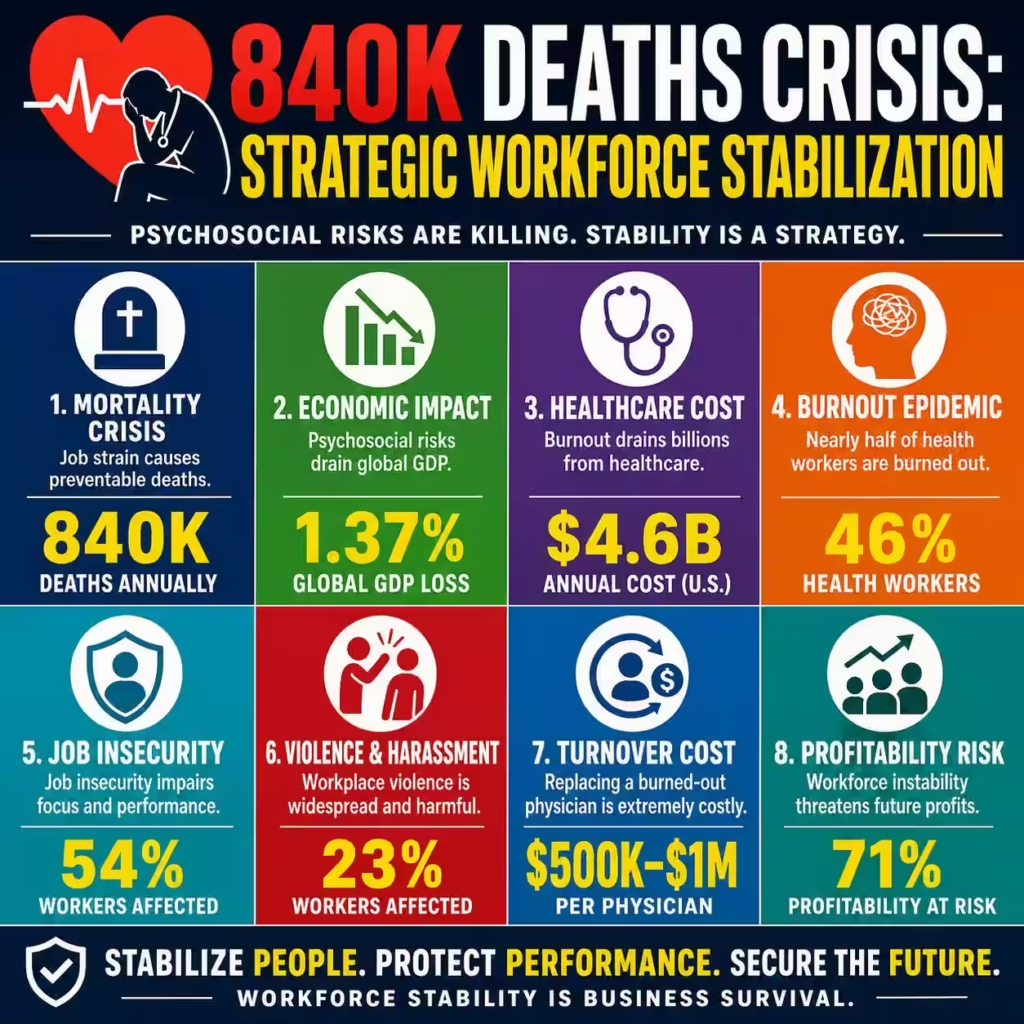
The International Labour Organization (ILO) recently confirmed that more than 840,000 people die each year from health conditions directly linked to job strain, including long working hours and workplace harassment. This staggering data represents a catastrophic failure in organizational design that transcends simple HR concerns to become a primary fiscal threat to global markets. Psychosocial risks are no longer abstract concepts but measurable killers that cause a 1.43% loss in GDP across Europe and Central Asia alone.
In the United States, burnout now costs the healthcare system an estimated $4.6 billion annually, driven largely by high-velocity provider turnover and clinical errors. Research from the 2026 Global Burden of Disease study indicates that while cardiovascular diseases cause the majority of these deaths, mental disorders are the leading cause of lost healthy life years. Modern healthcare executives must recognize that these 45 million disability-adjusted life years (DALYs) lost annually represent a massive depletion of skilled labor and institutional knowledge.
This crisis hits hardest in clinical environments where high demands and low control create a perfect storm for chronic physiological degradation and systemic collapse. Numerical data from the American Psychological Association’s 2025 survey shows that 54% of workers report job insecurity as a significant stressor, directly impacting their cognitive performance and diagnostic accuracy. Furthermore, the cost of replacing a single burned-out physician now ranges between $500,000 and $1 million, creating a recursive cycle of financial hemorrhaging for under-resourced hospitals.
Our analysis suggests that the current trajectory of “lean” staffing is mathematically unsustainable and will lead to a complete collapse of service delivery models by 2030. Leadership must pivot from viewing mental health as a “perk” to treating it as a core operational stability metric that dictates long-term solvency. By integrating psychosocial risk management into the foundational Occupational Safety and Health (OSH) systems, organizations can reclaim lost productivity and stabilize their operating margins effectively.
The transition to digital-first healthcare and AI integration have intensified these risks by blurring the lines between work and recovery. Data suggests that 35% of the global workforce now exceeds 48 hours per week, a threshold that significantly increases the risk of ischemic heart disease and stroke. This is not merely a labor issue; it is a profound business risk that necessitates immediate intervention through structural workflow redesign and executive accountability.
Strategic investment in psychological safety is no longer optional for firms wishing to maintain a competitive advantage in a tightening labor market. The 1.37% loss in global GDP is a direct reflection of suboptimal management practices that can be corrected with data-driven leadership and rigorous oversight. We provide a roadmap for this correction, moving beyond superficial wellness apps toward deep structural reform that addresses the root causes of workplace mortality and fiscal waste.
Carethix Critique: The Lethal Gap in Organizational Integrity
Carethix issues a severe critique of the current management landscape, which often prioritizes short-term throughput over the biological limits of the human workforce. The 840,000 deaths reported by the ILO are a direct indictment of a culture that rewards overextension while penalizing those who dare to speak out. Our analysis finds that 23% of workers globally have experienced workplace violence or harassment, yet reporting mechanisms remain woefully inadequate or retaliatory in nature.
This silence is a massive financial liability. Undetected psychosocial risks manifest in “presenteeism,” where employees are physically present but cognitively impaired by anxiety. Current OSHA penalties, which increased to a maximum of $165,514 for willful violations in 2025, are insufficient to deter systemic negligence in billion-dollar healthcare enterprises. We contend that the current regulatory environment fails to account for the secondary financial tremors caused by a traumatized and disengaged clinical workforce.
The gap between executive rhetoric on “wellness” and the reality of 13.5% RN turnover rates in 2025 highlights a dangerous disconnect in corporate governance. We observe that many healthcare systems rely on “resilience training” as a scapegoat to shift the burden of stress management onto the individual worker. This approach ignores the organizational hazards—such as chronic understaffing and administrative overload—that are the actual catalysts for cardiovascular and mental decline.
Factual data shows that 46% of health workers are experiencing chronic burnout, which is a 32% increase since 2018, proving that current interventions are failing miserably. The risk is not just human; it is legal and reputational, as evidenced by the 17 major healthcare strikes recorded by mid-2025 across the United States. Carethix asserts that failing to address these psychosocial hazards constitutes a breach of fiduciary duty to shareholders and a violation of the fundamental “do no harm” principle.
Furthermore, the lack of standardized psychosocial risk assessments across the B2B healthcare sector creates a massive data vacuum that obscures the true cost of job strain. Companies are hit with lower staff retention and suffering work performance because they treat mental health as a private matter rather than a workplace design flaw. This critique extends to the financial sector’s failure to price in the long-term liability of a decaying workforce when evaluating healthcare mergers and acquisitions.
Without a transparent, audited framework for human capital well-being, the reported 71% expected profitability for 2025 in the healthcare sector remains incredibly fragile. We demand a shift toward “Human Asset Auditing,” where psychosocial safety is a primary KPI for executive compensation and board-level oversight. The current silence on these issues is not a management strategy; it is a slow-motion liquidation of your most valuable and irreplaceable assets.
| Related Analysis: Pancreatic Cancer 24 Visits: Smart Triage Advantage 34-Case Salmonella Crisis: Smarter Buyer Protection 26K MRI Scan Crisis: Build Smarter Benefits |
Strategic Solutions: Engineering a Resilient Healthcare Infrastructure
To mitigate the catastrophic loss of 1.4% of GDP, organizations must implement a multi-layered psychosocial risk management framework that is fully integrated into core operations. Our research indicates that for every $1 invested in mental health support, organizations achieve an average return of $4 in recovered productivity and reduced absenteeism. The first solution is the implementation of Clinically Validated Mental Health Platforms that utilize tools like the PHQ-9 to track symptom improvement across the entire workforce.
This data-informed approach allows leaders to identify high-risk departments before they reach a “turnover tipping point” where staffing ratios become dangerous. Additionally, organizations should adopt the NIOSH “Impact Wellbeing” guide to transition from individual resilience models to organizational-level workflow optimization. By focusing on the system rather than the individual, hospitals can reduce the incidence of medical errors which currently cost billions annually.
The second solution involves a radical redesign of the “Effort-Reward Imbalance” through transparent, performance-linked compensation models and formal recognition programs. Statistics show that formal recognition can reduce turnover by 31%, saving a 500-bed hospital up to $3.5 million annually in RN recruitment costs alone. This must be paired with “Personalized Navigation” services that connect employees to trauma-informed care and medication management without any administrative friction.
By removing the “fear of negative consequences” mentioned in the ILO report, you create a culture of psychological safety that is essential for error reduction. Leaders should also mandate “Mental Health Days” that are distinct from traditional sick leave, encouraging proactive recovery before acute burnout occurs. These solutions are not merely benevolent gestures; they are high-ROI business imperatives that stabilize the workforce and improve patient outcomes significantly.
Finally, we recommend the adoption of “Flexible Scheduling Algorithms” that prioritize worker recovery time and eliminate mandatory overtime completely. Current data shows that 97% of hospital systems plan to expand flexible work options in 2025 to combat the 27.1% turnover rate in nursing specialties. By utilizing AI to optimize shifts based on both patient demand and employee fatigue levels, organizations can reduce the risk of cardiovascular events.
This also includes the integration of “Teletriage” for workplace injuries, providing immediate clinical assessment and reducing the stress of navigating complex workers’ compensation systems. Implementing these structural changes requires a firm commitment from the C-suite to treat human capital as a non-depreciating asset. Through these rigorous engineering solutions, you can transform your organization from a site of job strain into a center of high-performance health.
Prevention Methods: Safeguarding Future Human Capital and Growth
Prevention of job strain requires a proactive “Prevention Through Design” (PtD) approach that eliminates psychosocial hazards at the source rather than managing their symptoms. The primary prevention step is the execution of regular, anonymous “Psychosocial Risk Audits” that measure job demand, control, and support levels across all tiers. Multivariate analysis identifies that high job demand combined with low control increases the risk of depression by nearly fourfold among clinical staff.
By identifying these “toxic zones” early, you can intervene with workload redistribution and leadership training before patient safety and clinical outcomes are affected. Furthermore, organizations must establish “Zero-Retaliation Policies” for reporting harassment, backed by third-party investigative bodies to ensure total transparency. These audits should be conducted quarterly to capture changing workplace dynamics and the impact of new technologies.
A secondary prevention method is the mandatory training of all management personnel in “Mental Health First Aid” and supportive leadership styles. Data confirms that 70% of workers say recent policy changes have impacted their stress levels, highlighting the need for leaders who navigate uncertainty with empathy. This includes developing “Heat Illness Prevention Plans” and ergonomic assessments as part of a “Total Worker Health” strategy.
By adhering to the updated 2025 OSHA hazard communication standards, you ensure that every employee understands the physical and psychological risks inherent in their roles. Pre-emptive investment in “Staffing Buffers”—maintaining a 5-10% surplus of trained personnel—can prevent the cascade of stress that occurs during unexpected surges. This proactive capacity planning is essential for maintaining the mental health of frontline workers during public health crises or seasonal demand spikes.
Lastly, long-term prevention is achieved through “Career Pathing and Upskilling” that provides employees with a sense of growth and agency. The 2025 Deloitte outlook suggests that limited career growth is a top reason for departures, particularly among Millennials who now comprise a majority of the workforce. By offering subsidized continuing education and clear ladders for advancement, you create a “sticky” workforce that is resilient to external fluctuations.
This prevents the “Job Insecurity” stressor that the ILO identifies as a primary killer, replacing it with a culture of mutual investment and long-term loyalty. We also recommend the establishment of “Peer Support Networks” where experienced clinicians mentor new hires, reducing the isolation that leads to depersonalization. Future-proofing your organization requires this transition from reactive crisis management to a philosophy of proactive human development and care.
Carethix Key Takeaway: The Bottom Line on Human Sustainability
The ILO data is a final warning: 840,000 annual deaths and a 1.4% GDP loss—totaling approximately $1.6 trillion globally—are the price of organizational negligence. You cannot achieve sustainable profitability in 2025 and beyond by liquidating the physical and mental health of your employees, as absenteeism now costs $3,000 per employee. Carethix maintains that “Psychosocial Safety” is the new gold standard for B2B excellence and the only path to long-term operational resilience and growth.
Stop treating burnout as an individual weakness and start treating it as a systemic failure that requires an engineering-grade solution, such as ISO 45003. The ROI of 4:1 is clear—investing in your people is the most profitable decision you will ever make, potentially increasing share price by 10%. Protect your hearts, protect your minds, and you will protect your margins in an increasingly volatile global healthcare market.
FAQs:
How can healthcare systems justify “lean staffing” when 840,000 annual deaths and 1.4% GDP loss are directly linked to job strain?
Lean staffing is not efficiency—it’s a structurally flawed cost model that converts short-term margin gains into long-term mortality, turnover costs, and systemic financial collapse.
Why does the $4.6 billion annual burnout cost in U.S. healthcare persist despite widespread “wellness programs”?
Because wellness programs treat symptoms while ignoring operational root causes like workload intensity and control deficits, making them cosmetic fixes to a deeply broken system.
What is the real business impact of losing 45 million DALYs annually due to workplace stress and mental disorders?
This represents a massive erosion of skilled labor capacity and institutional knowledge that directly undermines productivity, care quality, and long-term organizational solvency.
How sustainable is a system where replacing one burned-out physician costs $500,000–$1 million amid rising turnover rates?
It is fundamentally unsustainable, as repeated high-cost replacements create a recursive financial drain that outpaces any perceived savings from understaffing.
Why are 46% burnout rates and a 32% increase since 2018 not triggering stronger executive accountability?
Because leadership still misclassifies psychosocial risk as an HR issue instead of a core financial and operational KPI, delaying the governance reforms required to prevent systemic failure.