NHS automation & the 500K staff crisis demand better care delivery, operational resilience, and stronger revenue growth.
The Operational and Economic Reality of Massive Healthcare Automation
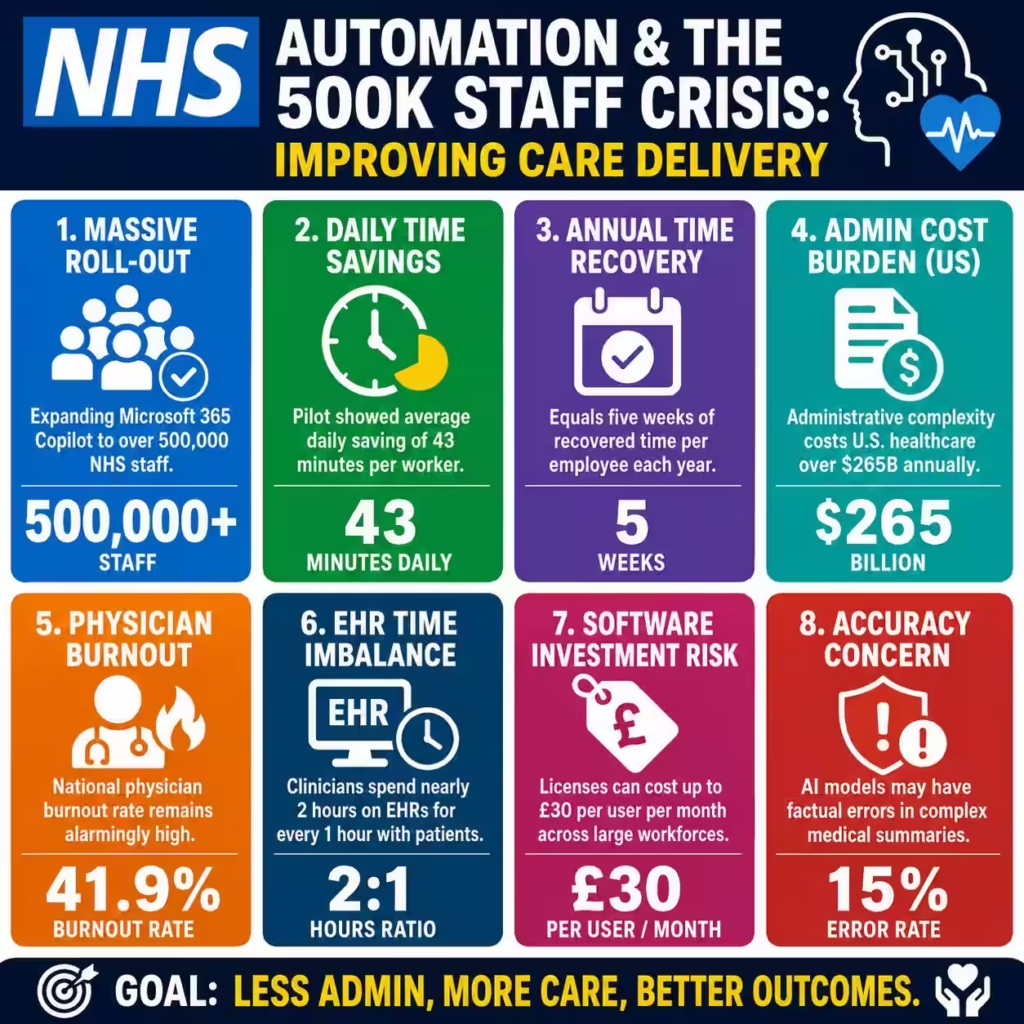
NHS England recently announced a major expansion of Microsoft 365 Copilot to over 500,000 staff members after a pilot involving 30,000 employees across 90 organizations demonstrated daily savings of 43 minutes per worker. This initiative represents a massive effort to curb administrative workloads and retrieve five weeks of recovered time per employee annually. By deploying such enterprise software, health systems seek to transition clinical personnel from keyboard tasks back to patient-facing care.
The core friction in clinical administration involves manual tasks like medical correspondence, bed management, and complex discharge planning. These bottlenecks slow patient throughput, decrease satisfaction, and directly drive the workforce burnout crisis. Solving this systemic issue requires a strategic integration of automated workflows and conversational artificial intelligence solutions.
In the United States, administrative complexity is a primary economic burden that consumes over $265 billion annually of total healthcare spending. This financial drain is part of a broader $760 billion to $935 billion annual landscape of wasteful clinical spending. Large-scale operational trials illustrate how technology can mitigate these costs through automated administrative assistance.
Statistics from the American Medical Association in 2025 and 2026 indicate that the national physician burnout rate remains high at 41.9%. Healthcare providers spend nearly two hours on electronic health records for every hour dedicated to direct clinical interactions. Recovering two working days each month per employee could alleviate this deficit and alter the financial trajectory of hospital operations.
This massive UK expansion serves as a critical test bed for global healthcare executives watching the economic returns of artificial intelligence. Operational efficiency is no longer a luxury but an absolute survival mechanism for overextended health networks. Leaders must assess whether horizontal tools like Microsoft Copilot can handle the highly specialized demands of clinical documentation.
When scaled across half a million users, a daily saving of 43 minutes yields millions of recovered hours monthly. This resource optimization allows systems to address the severe shortage of nursing staff and reduce patient waiting lists. However, achieving these gains requires a reliable underlying data infrastructure to ensure that automated summaries are clinically accurate.
The financial implications of this deployment extend beyond simple time savings to direct labor productivity metrics. Retaining clinicians through reduced bureaucratic burdens avoids the substantial recruitment costs associated with staff turnover. Organizations that successfully implement these platforms can stabilize their operating margins amidst rising labor inflation.
Ultimately, this case study underscores the shift from experimental artificial intelligence pilots to mandatory enterprise-wide rollouts. The success of this transition depends on careful change management and rigorous clinical oversight. Healthcare organizations must learn from this large-scale deployment to build more resilient administrative architectures.
Systemic Gaps and Risks: A Critique by Carethix
While the potential recovery of five weeks of staff time is encouraging, Carethix must highlight several systemic gaps in this deployment strategy. Deploying generic office productivity software across clinical settings presents substantial integration risks that can undermine patient safety. Generic large language models often struggle with the complex nuances of specialized clinical terminology and local medical protocols.
A primary concern is the accuracy of documentation in critical areas like discharge planning and medical correspondence. Industry research indicates that generic artificial intelligence models can produce subtle factual errors or hallucinations in up to 15% of complex medical summaries. If staff members do not carefully review every generated output, these automated errors could compromise clinical decision-making.
Furthermore, horizontal productivity tools lack deep, native integration with standard electronic health records systems. Without direct integration into platforms like Epic or Cerner, clinicians must manually copy and paste text between applications. This manual transfer introduces new steps into the clinical workflow, which directly contradicts the goal of reducing administrative friction.
Data security and compliance represent another major risk area for enterprise healthcare organizations adopting these tools. Under regulations like HIPAA in the United States, transmitting protected health information through external productivity systems requires rigid security standards. Any data leak or unauthorized processing of patient records could cause severe regulatory fines and a devastating loss of patient trust.
Carethix also questions the financial sustainability of licensing models for massive workforces without targeted utilization plans. Software licenses can cost organizations up to $30 per user monthly, amounting to millions of dollars in annual software expenditures. If employees only use these advanced tools for basic email drafting, the actual return on investment will remain extremely low.
The assumption that recovered time automatically translates into enhanced patient care is another operational oversight. Without structured workflow redesign, saved minutes often evaporate into other administrative inefficiencies or minor workplace distractions. Health systems must actively manage how freed hours are redirected toward direct clinical interactions and operational priorities.
Additionally, training a diverse workforce of over half a million staff members introduces monumental change management challenges. Varying levels of digital literacy across clinical teams can lead to unequal adoption rates and fragmented operational standards. Organizations often underestimate the resources required to deliver continuous, role-specific instruction for artificial intelligence systems.
Finally, the clinical documentation burden cannot be resolved by simply layering new technologies over inefficient legacy processes. True administrative reform requires a thorough redesign of clinical documentation requirements rather than just faster text generation. Failing to address these underlying systemic gaps will turn promising software initiatives into expensive distractions.
Political Analysis: Government-Led AI Policy Reshapes Healthcare Workforce Strategy
Governments are increasingly treating artificial intelligence as a strategic healthcare infrastructure investment rather than a discretionary digital innovation. NHS England’s expansion of Microsoft 365 Copilot to more than 500,000 staff follows a pilot involving approximately 30,000 employees across 90 NHS organizations, demonstrating average productivity gains of 43 minutes per employee per day, equivalent to nearly 180 hours or about 4.5–5 working weeks recovered annually. This initiative aligns with the UK Government’s broader AI transformation agenda and comes as the NHS in England operates with an annual budget exceeding £190 billion, while managing over 1.7 million patient interactions every day and addressing waiting lists of roughly 7.3 million treatment pathways.
Political pressure to improve healthcare productivity continues to intensify as workforce shortages and fiscal constraints challenge public health systems worldwide. In the United States, national health expenditure exceeded US$4.9 trillion in 2023, representing approximately 17.6% of GDP, while administrative activities continue to consume an estimated US$265 billion annually and total wasteful healthcare spending remains between US$760 billion and US$935 billion each year. Meanwhile, physician burnout remains elevated at approximately 42%, and clinicians still spend nearly 2 hours on electronic health record documentation for every 1 hour of direct patient care, reinforcing policy incentives for AI-assisted workflow modernization.
Healthcare regulators are simultaneously strengthening governance expectations around clinical AI deployment, cybersecurity, and patient privacy. Organizations adopting generative AI must comply with frameworks such as the UK’s Data Protection Act 2018, UK GDPR, the NHS AI and Data Strategy, and evolving guidance from regulators overseeing software used in clinical environments, while U.S. providers remain subject to HIPAA and expanding federal AI governance initiatives. Consequently, political success will depend not only on achieving measurable productivity gains but also on demonstrating transparent governance, clinical safety, auditability, and public trust across increasingly AI-enabled healthcare systems.
Strategic Solutions for Enterprise Healthcare Systems
To maximize the return on artificial intelligence investments, enterprise health systems must implement targeted clinical-grade solutions. Instead of relying solely on generic office tools, organizations should deploy specialized ambient intelligent scribes designed specifically for patient encounters. These systems utilize advanced acoustic models to capture clinical dialogue and automatically structure it into standardized medical notes.
Studies in 2025 published in JAMA Network Open showed that ambient AI scribes reduced clinician burnout from 51.9% to 38.8% within 30 days. This drop is accompanied by a massive reduction in after-hours documentation, commonly called clinician pajama time. By automating the creation of progress notes directly within the electronic health records, systems eliminate unnecessary copy-paste steps.
Furthermore, organizations must integrate agentic artificial intelligence tools to automate complex backend operational processes. These specialized decision agents can autonomously draft prior authorizations, process referrals, and resolve complex billing discrepancies. Implementing agentic workflows can reduce referral processing times from three hours down to under 15 minutes per patient.
A unified healthcare data layer is essential to support these advanced artificial intelligence integrations. By centralizing patient data, systems enable machine learning models to access complete, real-time context across departments. This comprehensive access ensures that clinical summaries and operational decisions are based on accurate, up-to-date information.
To address safety concerns, healthcare networks must establish clinical validation engines staffed by designated medical professionals. These validation teams act as a human-in-the-loop safety net, verifying the clinical accuracy of automatically generated documents. This hybrid model minimizes the risks of medical hallucinations while preserving the time-saving benefits of automated drafts.
Health systems should also implement role-based software licensing structures to optimize their technological spending. Rather than purchasing expensive premium licenses for every employee, organizations should allocate software based on actual administrative demand. This selective distribution ensures that high-cost tools are concentrated where they can generate the highest measurable return.
Change management programs must be tailored to the specific operational workflows of different clinical specialties. Emergency medicine and primary care require vastly different documentation approaches compared to highly specialized surgical departments. Customizing training modules to these distinct clinical environments accelerates adoption rates and improves user satisfaction scores.
Finally, organizations must establish clear key performance indicators to measure the financial and operational impact of technology. Metrics should track actual hours recovered, reductions in documentation backlog, and improvements in patient discharge times. Rigorous data collection allows healthcare executives to continuously refine their artificial intelligence strategies and justify ongoing investments.
Preventative Methodologies for Future Operational Friction
Preventing future operational friction requires healthcare organizations to establish proactive governance frameworks before deploying artificial intelligence at scale. Executive leaders must form multidisciplinary committees comprising clinical, technical, legal, and financial stakeholders to guide implementation. These committees are responsible for establishing clear safety protocols and assessing the long-term viability of software vendors.
A vital preventative measure is continually auditing data security practices to protect patient confidentiality. Healthcare networks must conduct regular vulnerability assessments and end-to-end encryption checks on all automated communication channels. Maintaining strict compliance with evolving data privacy regulations prevents costly security breaches and associated legal penalties.
Organizations must also establish strict guidelines for algorithm updates to prevent performance drift in automated tools. As software vendors update their machine learning models, the accuracy and behavior of these systems can change unexpectedly. Regular testing protocols ensure that any drop in the quality of clinical summaries is detected before it affects care.
To prevent workforce resistance, health systems must involve clinical staff in the selection and design of new tools. Designing software interfaces that align with existing clinical patterns minimizes the cognitive load placed on overextended workers. When clinicians feel ownership over technological changes, adoption rates rise and the risk of implementation failure decreases.
Financial leaders should implement cost-control guardrails to avoid unexpected increases in software licensing expenditures. Contracts with major technology providers should include flexible scaling options that match changing staffing levels and clinical needs. This financial agility prevents organizations from paying for unused digital resources during periods of workforce contraction.
Systems must also establish redundant backup procedures to maintain operational continuity during unexpected software outages. If a central artificial intelligence service experiences downtime, clinical workflows must seamlessly transition to pre-established manual protocols. Training staff on these contingency plans prevents severe delays in patient processing and maintains hospital safety margins.
Another critical step is establishing continuous feedback loops between clinical users and technical support teams. Rapidly addressing user-reported glitches or workflow bottlenecks prevents frustration from turning into systemic disengagement. Sustained engagement with the platform is necessary to realize the long-term operational efficiencies promised by software developers.
Lastly, health systems must advocate for industry-wide standardization of artificial intelligence safety and interoperability protocols. Promoting open standards allows different digital tools to communicate seamlessly, reducing future integration costs and vendor lock-in. Collaborative efforts across the healthcare industry are essential to build a secure, efficient, and sustainable technological future.
Strategic Synthesis: Carethix’s Key Takeaways
The major expansion of artificial intelligence tools across healthcare systems represents a definitive shift in modern medicine. However, Carethix asserts that technology alone cannot repair the foundational fractures of clinical operations. True operational transformation requires a complete restructuring of administrative processes alongside technological adoption.
Organizations must recognize that recovering five weeks of staff time is an operational opportunity, not an automatic guarantee. Without aggressive leadership and deliberate workflow redesign, these saved hours will easily dissipate into unproductive activities. Executives must be accountable for actively directing recovered labor capacity back to direct, high-value patient care.
Furthermore, Carethix advises against relying on generic, horizontal tools for highly specialized clinical workflows. The medical sector demands clinical-grade, vertically integrated solutions that understand the complex terminology of medical practice. Investing in horizontal office suites without clinical context is a short-term compromise that increases risk and limits long-term value.
The economic reality of modern healthcare dictates that operational efficiency must directly translate into improved financial margins. Reductions in documentation time must be paired with strategic adjustments in scheduling and patient throughput. Health systems that fail to link technology adoption with measurable financial metrics will struggle to justify their capital investments.
Moreover, change management is the defining factor that separates successful deployments from costly technical failures. Technology is only as effective as the clinicians who utilize it daily during patient care. Prioritizing continuous clinical training and support is essential to achieve the full potential of digital health tools.
Data governance and cybersecurity must remain at the forefront of every healthcare leader’s strategic priority list. As systems become more interconnected, the attack surface for potential data breaches expands dramatically. Implementing zero-trust architectures is a mandatory prerequisite for deploying large-scale artificial intelligence applications.
Looking forward, the gap between technologically mature health systems and lagging organizations will continue to widen. Proactive adoption of validated automation tools is no longer a competitive advantage but a baseline operational requirement. Leaders who hesitate to modernize their administrative infrastructure risk losing both their clinical workforce and their market position.
In conclusion, Carethix views the integration of artificial intelligence as a powerful catalyst for organizational renewal. By systematically addressing administrative waste, healthcare systems can build a more sustainable and humane environment for care. The future belongs to those who combine technological innovation with disciplined operational execution and clinical excellence.